
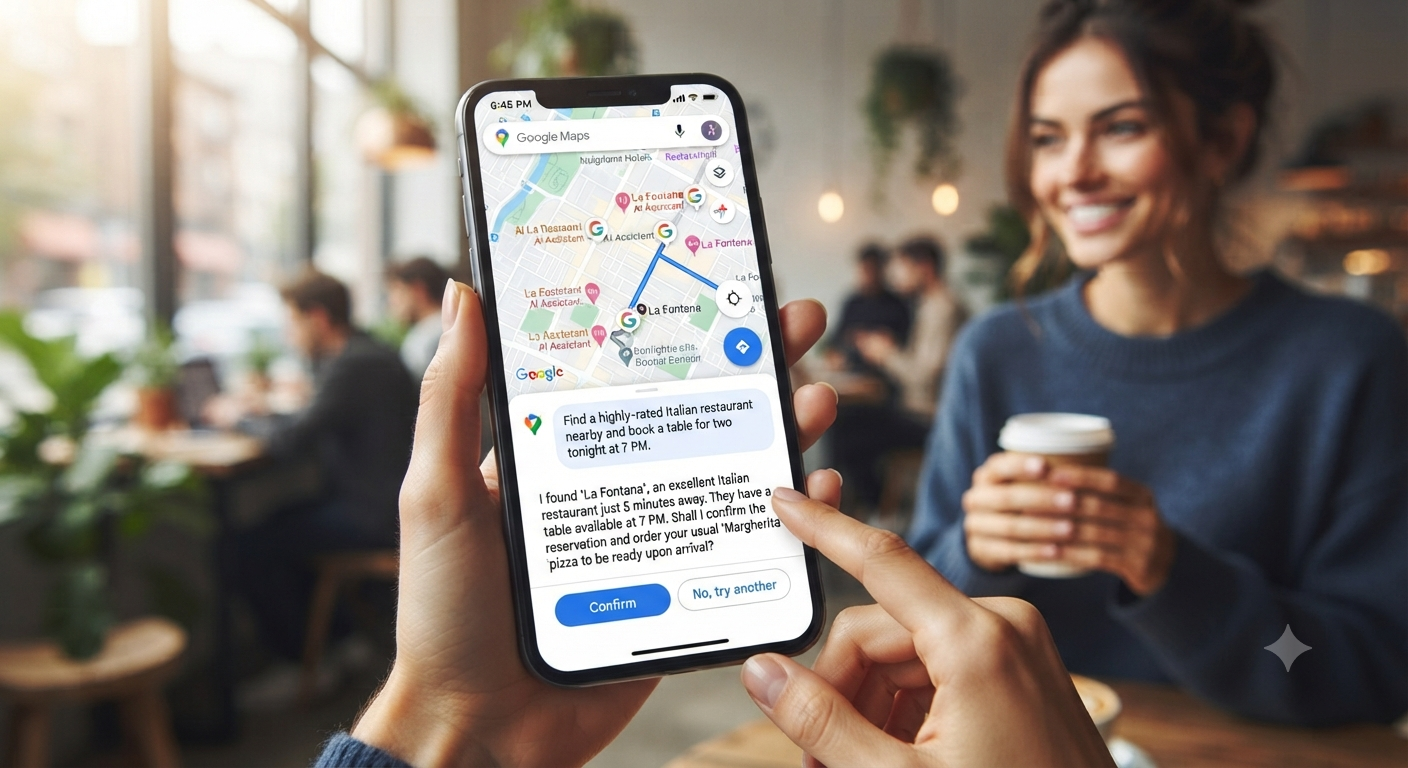
Google Maps is moving beyond navigation.
Google has introduced new agentic capabilities to its Gemini-powered Ask Maps feature, allowing users to use conversational requests to accomplish tasks such as ordering food, finding hotels and discovering local events.
The update represents a significant change in what Google Maps is designed to do. Instead of simply helping people find places, Google wants Maps to help them complete tasks in the real world.
From Finding Places to Getting Things Done
Traditionally, using Google Maps to order food required several steps: search for restaurants, check menus, choose a restaurant, open a separate ordering platform and then place your order. Ask Maps is designed to bring more of that process into a single conversation.
A user can describe what they want, including dietary requirements and where they want to pick up the food. Ask Maps can then identify suitable restaurants and, after the user chooses one, add the requested items to the order cart.
Google says food-ordering capabilities are rolling out with partners including Square and Toast, with Uber Eats support coming soon. Users still review and complete the transaction through the relevant ordering service.
AI Can Help Find the Right Hotel
The new capabilities also extend to accommodation. Rather than simply searching for hotels in a particular location, users can describe the type of accommodation they want — for example, someone attending a conference could ask Maps to find a reasonably priced, highly rated hotel close to restaurants and other amenities.
Google says Ask Maps can compare real-time prices and availability to help users identify suitable options. The same conversational approach can be used to discover local events, including concerts and comedy shows, with links to tickets.
Google Maps Can Now Use Your Personal Context
One of the more significant additions is Personal Intelligence. Users can choose to connect Ask Maps with Gmail, allowing the system to take relevant information from emails into account when providing recommendations. Google says Calendar integration is also planned.
For example, if your Gmail contains information about an upcoming flight or dinner reservation, Maps can use that context when helping you plan activities. The feature is designed to reduce the amount of information users need to repeatedly provide to an AI assistant.
This also highlights one of the biggest advantages — and challenges — of agentic AI: context. The more information an AI system can access, the more useful its recommendations can potentially become. At the same time, users and businesses will need to pay increasing attention to permissions, privacy and how personal data is being used.
Real-Time Transit Information Gets an Upgrade
Google is also bringing real-time transit information into Ask Maps. A new transit widget can provide live information about buses, trains, subways and ferries, including delays and changing departure times. That means the assistant can combine several pieces of information when helping someone plan a journey.
Why This Is Important for Businesses
The biggest implication isn't necessarily the food-ordering feature itself. It's the fact that AI is beginning to sit between customers and businesses.
The AI becomes the interface through which the customer discovers the business.
A customer may no longer search for a restaurant, visit its website, read its menu and then make a decision manually. Instead, the customer could simply tell an AI agent: "Find me a highly rated restaurant nearby with vegetarian options and order dinner for pickup." That could have major consequences for restaurants, hotels, retailers, travel companies and other businesses that depend on online discovery.
Businesses May Need to Optimise for AI Agents
Search engine optimisation has traditionally focused on helping websites appear in search results. The rise of agentic AI introduces another question: can AI agents understand and interact with your business? Businesses may increasingly need:
- Accurate business information
- Up-to-date opening hours
- Structured product and service information
- Real-time availability
- Machine-readable menus and catalogues
- Online booking and ordering systems
- Secure payment integrations
- APIs that allow external systems to interact with their services
This could become an important part of the next phase of digital transformation. If you want to check how machine-readable your own site is today, run the free AEO audit or read about our Answer Engine Optimization service.
What This Could Mean for Kenyan Businesses
The opportunity is particularly interesting for businesses in Kenya as digital ordering, online bookings and mobile commerce continue to expand. Imagine a customer asking an AI assistant to find a Nairobi restaurant with nyama choma, parking and good reviews and then place an order — or to find a Mombasa hotel for the weekend, near the beach and within budget.
For those experiences to work effectively, businesses need more than a basic website. Their information needs to be accurate, accessible and connected to digital systems that AI agents can understand and interact with. This creates an opportunity to invest in APIs, online booking systems, digital catalogues and automated customer service.
The Bigger Shift: Agentic Commerce
Google's update is part of a much larger movement toward agentic commerce. The traditional online journey looked like: search, website, compare, choose, checkout. The emerging model could become: tell an AI what you want, the AI searches, the AI compares, the AI takes action, and the human approves.
That is a fundamental change in how people could interact with the internet. Websites will still matter, but the interface through which customers reach them may increasingly be an AI agent rather than a browser search page.
Our Take
The important development isn't simply that Maps can help users find a restaurant or hotel. It's that Google is attempting to make the AI take the next step after finding the information. A chatbot can tell you where to eat; an agent can find the restaurant, check the options, add your meal to a cart and help complete the transaction.
As these systems become more capable, businesses will need to think beyond traditional websites and search rankings. They will need to make their digital infrastructure ready for a future where AI agents — not just humans — are interacting with their businesses.
Sources & further reading
Tech briefing
Get the week's most important AI, automation, and technology news in your inbox.
Comments
No comments yet — be the first to share your thoughts.