AI built around your business

Custom AI Development & Solutions for Businesses

Build AI around the way your business actually works. Exponential Automations develops custom AI systems that connect your workflows, documents, business data and existing tools to solve specific operational problems.

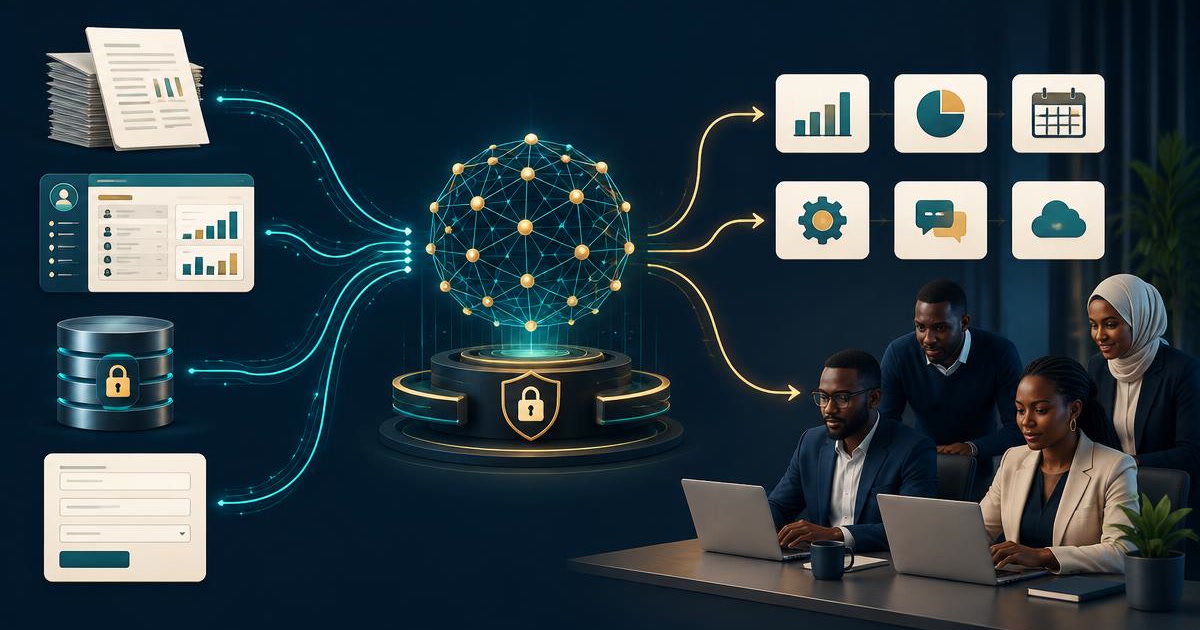
Custom AI development system connecting business data and workflows.

What Is Custom AI Development?

Custom AI development is the process of designing and building an AI system around a company's specific workflows, data, documents and operational requirements. Unlike generic AI tools, a custom AI solution is configured to work with the information, processes and systems a business already uses.

AI Built Around Your Business

Most businesses already hold the raw material for a useful AI system — they just haven't had a way to put it to work. Internal documents, SOPs, contracts, reports, customer records, product information and other operational data tend to sit in folders, inboxes and shared drives, accessed manually whenever someone needs an answer.

Custom AI turns that existing material into something staff can actually use. In practice, this usually shows up as:

  • Faster access to information staff would otherwise have to search for manually
  • Automated document processing — extracting and structuring data instead of reading it by hand
  • Internal knowledge retrieval, so employees can ask a question instead of hunting through files
  • Workflow assistance for repetitive, knowledge-intensive steps
  • Structured data extraction from unstructured sources like PDFs and forms
  • Decision support that surfaces relevant information in one place
  • Direct connections between the AI system and the tools a business already runs on

None of this requires replacing existing software. It requires building an AI layer that understands how the business already operates.

What Can a Custom AI System Do?

AI Knowledge Assistants

Give employees a natural-language interface to company knowledge such as SOPs, policies, product documentation and internal resources. Instead of searching through folders or asking a colleague, staff can ask a question directly and get an answer drawn from approved company sources. Related: AI Chatbots.

AI Document Processing

Extract, classify, summarize and structure information from documents such as contracts, invoices, forms and reports. A firm processing hundreds of contracts a month, for example, can have key terms and dates extracted automatically instead of reviewed line by line.

AI Agents & Business Assistants

Build AI-powered assistants that can support defined business workflows and interact with connected systems where appropriate. These are scoped to specific tasks — such as retrieving a customer's order status or drafting a first response — rather than acting freely across the business.

Decision-Support Systems

Bring relevant business information together so employees and managers can find information and evaluate decisions faster, without pulling data manually from multiple systems.

Custom AI Integrations

Connect AI systems with approved business applications, databases, APIs, CRMs and internal tools, so the AI layer works with live business data rather than a static export. See also: CRM Setup & Integration and Workflow Automation.

AI-Powered Internal Tools

Build purpose-specific AI interfaces around a company's unique processes rather than forcing employees into a generic software workflow that wasn't designed for how the team actually works.

Custom AI vs Generic AI Tools

Generic AI tools are useful for general tasks. Custom AI systems are built for a specific business. Neither is universally “better” — the right choice depends on how specialized the workflow is.

FeatureGeneric AI ToolCustom AI System
PurposeGeneral-purpose assistanceBuilt for a specific workflow or operational problem
Business dataNot connected by defaultConfigured to work with your documents and records
Workflow integrationLimited or manualConnects to the tools you already use
Knowledge sourcesPublic/general training dataYour company's own policies, files and systems
User experienceOne-size-fits-all interfaceInterface shaped around how your team works
Security/access controlDepends on the provider's settingsScoped access controls set during discovery
CustomizationMinimalBuilt around your terminology and processes
Ongoing improvementVendor-driven updatesRefined as your operations change

Custom AI is particularly useful when a business has specialized workflows, proprietary information, complex documents or several systems that need to work together. A generic AI tool may be entirely sufficient for simpler, general-purpose tasks.

Where Custom AI Can Help

Professional Services

Retrieving clauses, obligations or precedent from large volumes of contracts and case files without manual review.

Healthcare

Structuring intake forms, records and reports so staff can find relevant information faster, with access controls scoped to patient data sensitivity.

Financial Services

Extracting and cross-checking data from statements, applications and compliance documents.

Real Estate

Structuring listing data, contracts and client records into a searchable, queryable system.

Operations

Giving teams a single place to ask process or SOP questions instead of routing them to a supervisor.

Customer Support

Surfacing the right internal knowledge to a support agent in seconds instead of minutes.

Document-Heavy Businesses

Turning large volumes of unstructured paperwork into structured, searchable data.

No client names, statistics or results are cited above. If a completed project matches one of these use cases, explore our Case Studies.

How Our Custom AI Development Process Works

01

Discovery & Business Analysis

Understand your workflows, data, bottlenecks and desired outcomes.

02

AI Feasibility & Solution Design

Determine which AI approach, data sources, integrations and controls are appropriate.

03

Development & Integration

Build the system and connect it with approved business tools and data sources.

04

Testing, Launch & Improvement

Test the system, launch it and refine it as requirements and business processes evolve.

Timelines depend on scope and data complexity, and are confirmed during discovery.

How We Approach AI Data Security

Custom AI systems are built with access-controlled integrations, so only authorized systems and users can reach connected business data. Authentication and role-based access are configured where applicable, and data-source permissions are scoped so the AI system only reaches what it's meant to.

Security and compliance requirements are identified during the discovery phase, and industry-specific considerations — such as handling client records in professional services, patient data in healthcare, or financial information in banking — are factored into the solution design rather than treated as an afterthought.

Is Custom AI Right for Your Business?

Custom AI is most useful when your business has specialized workflows, large amounts of internal knowledge, document-heavy processes or existing systems that need to work together.

Custom AI may be useful if:

  • Employees repeatedly search through internal documents to find information
  • Teams manually extract information from documents
  • Important business knowledge is scattered across files
  • Employees repeatedly answer the same internal questions
  • Existing software doesn't fit a specialized workflow
  • Business data needs to be surfaced through a natural-language interface
  • Multiple systems need an AI layer between them

If your needs are simpler — a single general task, no proprietary data involved, no integration requirements — a standard, off-the-shelf AI tool may be entirely sufficient, and that's a reasonable place to start.

Frequently Asked Questions About Custom AI Development

What is custom AI development?
Custom AI development is building an AI system designed around a specific company's workflows, data and documents, rather than adapting a generic tool. It's configured to work with the information and systems a business already uses.
What is the difference between custom AI and ChatGPT?
ChatGPT and similar tools are general-purpose assistants with no access to your company's private data by default. A custom AI system is connected to your specific documents, records and tools, and is scoped to the workflows you need it to support.
How can custom AI help a business?
It reduces time spent searching for information, automates document-heavy tasks, and gives staff a way to ask questions and get answers from company data directly, instead of digging through files.
What can a custom AI system be used for?
Common uses include knowledge assistants, document processing, decision support, workflow-specific assistants and integrations that connect AI to existing business tools.
Can custom AI work with our existing business data?
Yes. Custom AI systems are built to work with your existing documents, records and data sources rather than requiring you to migrate everything into a new platform.
Can custom AI integrate with our CRM and other business systems?
Yes, where access is available. Integrations are built with approved, access-controlled connections to systems such as CRMs, databases and internal tools.
How long does custom AI development take?
Timelines depend on the scope of the project and the complexity of the data and integrations involved, and are confirmed during discovery before development begins.
How much does custom AI development cost?
Cost depends on the scope, integrations and complexity of the system. Pricing is discussed after an initial discovery call, once requirements are understood. See Pricing for general guidance.
Is custom AI suitable for small and medium-sized businesses?
Yes. Custom AI is scoped to the size and complexity of the business — an SME with a document-heavy process can benefit from a focused system without needing enterprise-scale infrastructure.
How do you protect business data in a custom AI system?
Through access-controlled integrations, scoped data permissions and authentication appropriate to the system, with specific security requirements identified during the discovery phase for the industry involved.

For general guidance on project costs, see Pricing.

Have a business process you think AI could improve?

Book a free strategy call and we'll assess the workflow, data requirements and potential AI approach.