
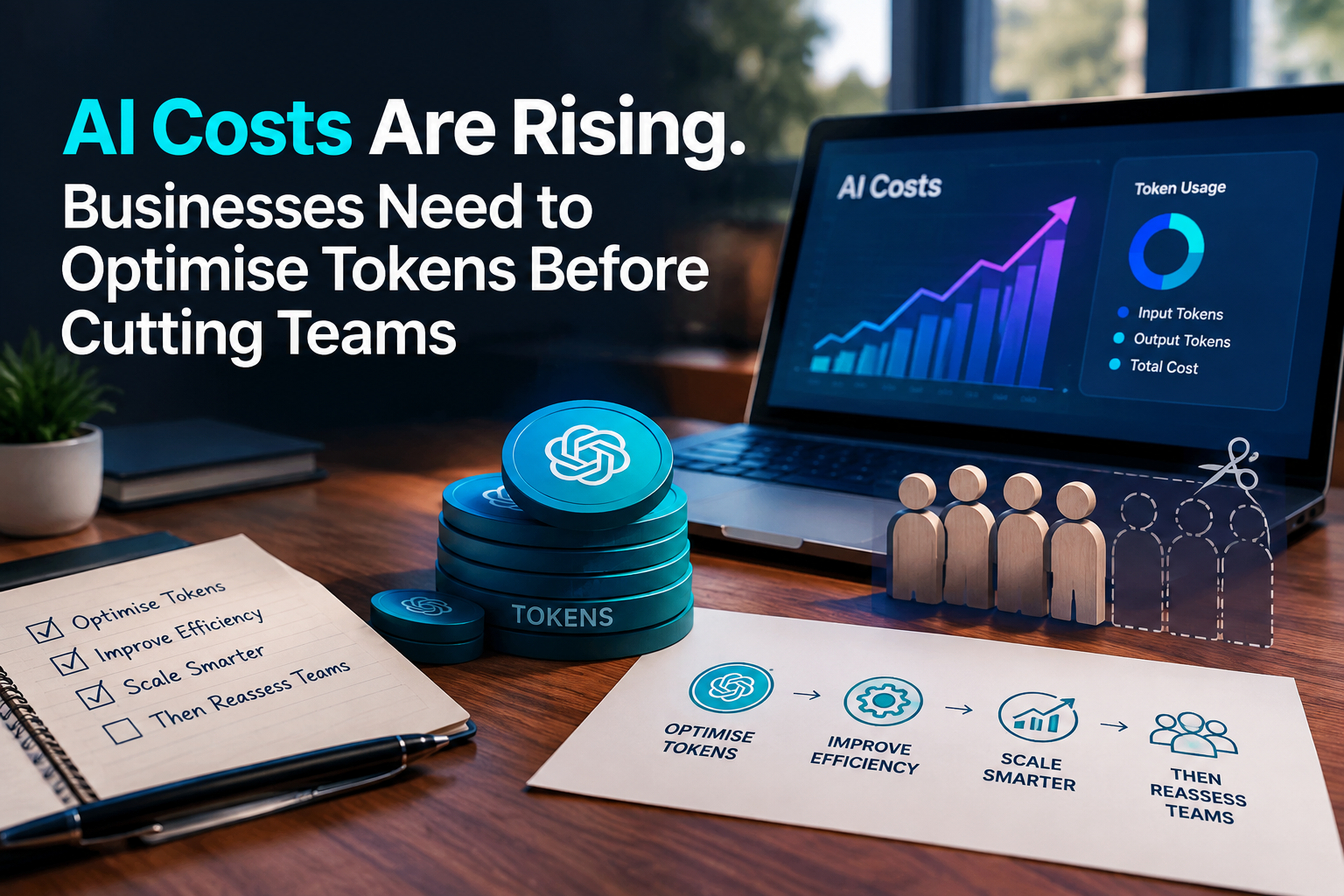
As businesses adopt AI more aggressively, a new cost is appearing on technology budgets: tokens.
Tokens are the units AI models use to process and generate information. A simple chatbot conversation may consume relatively few, but coding agents, research agents, and automated business workflows can make many model calls and process millions of tokens in a single task.
That creates a new management challenge: companies need to control AI spending without accidentally removing the people who know how to use the technology effectively.
A July 2026 analysis by Artificial Intelligence News highlighted this tension after NVIDIA CEO Jensen Huang argued that highly paid engineers should make significant use of AI computing. He suggested that if a $500,000 engineer consumed less than $250,000 of AI tokens in a year, he would worry that the engineer was not using enough AI. NVIDIA was also working toward spending as much as $2 billion annually on tokens for its engineering organisation.
The comment captures a broader shift: AI usage is increasingly treated as a productivity resource rather than simply another software subscription. But what happens when AI becomes expensive enough that companies start cutting people to pay for it?
Tokens Are Becoming a Real Business Cost
A token is a unit of information processed by an AI model. Providers can charge for input tokens, output tokens, cached tokens, and the additional reasoning tokens used by some systems. Pricing varies, but greater use generally means greater consumption-based cost.
This matters particularly with AI agents. A traditional chatbot may receive one request and generate one answer. An agent can plan, search, call a tool, read the result, reason, try again, update a system, and generate a response. Every step can involve more model processing, so agentic AI can create substantially more usage than chat-based AI.
The Problem Isn't That AI Is Too Expensive
Simply limiting AI usage can be the wrong response. The useful question is whether a company gets enough value from what it pays for. An engineer using $200 of AI to complete work that would otherwise cost thousands in labour may represent excellent economics; the same spend without a useful result does not.
Token consumption alone is not a productivity metric. AI spending needs to be connected to outcomes.
NVIDIA's Approach Highlights the Shift
Huang's comments illustrate how technology companies increasingly view AI as leverage. NVIDIA has incorporated AI into engineering and is developing agentic workflows intended to increase the amount of work engineers can accomplish.
NVIDIA's GTC material describes development environments where agents can access repositories, databases, tools, and knowledge bases while organisations define permissions and human-review checkpoints. The model is not simply an engineer using a chatbot; it is an engineer, AI agents, tools, and company data working as a larger engineering system.
More Tokens Do Not Automatically Mean More Productivity
A large token bill can indicate heavy AI use, but it does not prove valuable output. An agent can generate code that is discarded, a research agent can process millions of tokens without a useful insight, and a support system can handle many conversations while failing to resolve customer problems.
The important metric is not how many tokens were used, but what those tokens produced.
Gartner Finds Workforce Cuts Do Not Guarantee Better AI Returns
Gartner surveyed 350 executives at organisations with at least $1 billion in annual revenue that were piloting or deploying AI agents, intelligent automation, or other autonomous technologies. Around 80% reported workforce reductions, but Gartner found no meaningful relationship between the level of workforce reduction and improved return on investment.
Cutting employees can create budget room, but it does not create returns by itself. The research instead points toward investing in people who can guide, govern, and scale autonomous systems. Headcount reduction should not be treated as proof that an AI strategy is working.
Uber Shows the Other Side of the Problem
Uber expanded access to agentic coding tools but later introduced a $1,500 monthly spending limit per employee for each AI coding tool after its annual budget was used much earlier than expected. The reported limits applied to tools including Claude Code and Cursor, with employees able to monitor usage through internal dashboards.
AI adoption can grow faster than finance teams expect. Agentic use changes the calculation, so AI needs cost management similar to cloud infrastructure.
The First Solution Should Be Better AI Cost Engineering
Before cutting teams, businesses can often reduce unnecessary AI consumption through caching, model routing, retrieval, and better prompt design.
Prompt Caching
When a workflow repeatedly sends the same instructions or reference material, it may not need to process that content from scratch each time. Prompt caching allows repeated input to be handled at a lower cached-input rate, with meaningful savings for long-running agents.
ProjectDiscovery Provides a Real-World Example
Cybersecurity company ProjectDiscovery reported increasing its cache hit rate from about 7% to 84% in its autonomous security-testing platform, Neo. It reported 59% overall LLM cost savings and later approximately 66–70% savings during optimisation, with 9.8 billion tokens served from cache in the analysed period.
The lesson is architectural: instead of simply telling employees to use less AI, redesign the system so the same work requires less expensive processing.
Use the Right Model for the Right Task
Not every task needs the most powerful model. Basic classification can use smaller, lower-cost models; complex reasoning can be routed to more capable models; and repetitive high-volume work can use optimised batch workflows. This can cut cost without reducing output.
Retrieval Can Reduce Unnecessary Context
Sending an entire knowledge base to answer one specific question makes little economic sense. Retrieval-augmented generation can identify relevant material and send only that context, reducing processed information while preserving useful access.
Prompt Design Matters Too
Poor workflows repeatedly send the same instructions, unnecessary examples, old conversation history, irrelevant documents, or duplicate context. Better prompt and context engineering reduce both cost and latency. The objective is not to make AI think less, but to make sure it considers the right information.
AI Costs Need Their Own Monitoring
As AI moves into production, companies need visibility beyond one monthly bill.
- Which department, application, agent, and workflow consume the tokens?
- Which model is being used and what does each task cost?
- Which workflows create the most value?
- How often does AI fail and require human rework?
AI observability and cost attribution are becoming important because traditional software licensing does not map neatly onto systems whose cost scales with usage.
The Human Side of AI ROI
Reducing infrastructure cost solves only half the problem. Companies must decide whether savings should reduce costs further, expand the system, train employees, or hire more people. Gartner's research suggests organisations improving AI ROI invest in people who can guide and scale autonomous systems rather than treating workers only as costs to remove.
The Entry-Level Talent Problem
AI coding tools can automate work traditionally assigned to junior developers, improving short-term productivity. But those tasks also build experience. Eliminating too much entry-level work may eventually create a shortage of engineers capable of supervising complex AI systems. Workforce planning therefore needs to consider not only today's headcount but the skills required five years from now.
Klarna Shows Why Automation Needs Human Oversight
Klarna aggressively expanded AI in customer support and said its assistant was doing work equivalent to hundreds of service employees. In 2025, CEO Sebastian Siemiatkowski acknowledged that the focus on AI-led cost reduction had gone too far and that service quality had suffered. The company moved toward greater human involvement again.
The lesson is not that AI service fails, but that removing humans can create costs elsewhere. A cheaper interaction is not necessarily a better one.
AI Should Be Measured Against Business Outcomes
- Cost per resolved support case
- Cost per qualified lead
- Hours saved per employee
- Revenue per AI-assisted sales process
- Cost per completed software task
- Percentage of output requiring rework
- Human escalation rate
These measurements connect AI consumption to performance. Token usage becomes an input metric rather than the final objective.
What This Means for SMEs
SMEs do not need multinational budgets to encounter the same problem. AI subscriptions, automation platforms, API usage, CRM software, WhatsApp integration, cloud storage, and other SaaS tools can together become a meaningful monthly bill. The answer is not automatically to remove the tools, but to understand which ones produce measurable value.
What Could This Mean for Kenyan Businesses?
A Kenyan SME automating customer enquiries might use an AI agent to answer questions, qualify leads, and update a CRM. It should know how many enquiries the system handles, how many leads it generates, the cost per interaction, the share needing human intervention, time saved, and whether sales increase.
Those questions make AI adoption more disciplined and help a business distinguish useful automation from technology that merely reduces visible workload.
A Practical AI Cost Strategy
- 1.Measure — track tokens, model costs, API calls, workflow executions, and human rework.
- 2.Optimise — use caching, better prompts, retrieval, and appropriate model selection.
- 3.Automate — connect AI to business systems so staff do not manually move information between applications.
- 4.Govern — set spending limits, permissions, approval rules, and escalation procedures.
- 5.Measure the outcome — connect AI spending to revenue, time saved, quality, and customer results.
AI Spending Is Becoming a Management Discipline
Companies learned to manage cloud infrastructure with monitoring, budgets, quotas, and FinOps. AI requires similar discipline plus visibility into model choice, tokens, reasoning effort, agent behaviour, context size, tool calls, and task success. Cost management is therefore closely connected to product design and workflow architecture.
The Bigger Shift: Tokens Are a Resource, Not a Goal
NVIDIA's investment shows how important AI consumption has become in technology companies, but the takeaway should not be to spend as many tokens as possible. It should be to use enough AI to maximise productive output, then engineer the system so each unit of spending creates as much value as possible.
Our Take
The debate is often framed as a choice between employees and AI tokens, but businesses do not necessarily have to make that choice. AI should be infrastructure that increases the productivity of the people using it.
Before reducing a team to pay for AI, examine whether the business is using unnecessarily expensive models, processing unnecessary context, failing to cache, repeating work, running agents without controls, automating low-value workflows, or failing to track results.
Evidence suggests AI should be managed around outcomes rather than raw usage or raw headcount. Gartner found workforce reductions alone did not correlate with better returns, while ProjectDiscovery showed that engineering the AI stack can materially reduce model costs.
For Kenyan businesses, start with one workflow. Measure what it costs today, automate repetitive parts, track and optimise AI usage, measure the result, and only then decide whether to scale. The future may belong not to companies with the biggest AI budgets, but to those that convert every unit of compute and every hour of human effort into measurable value.
Sources: Artificial Intelligence News; NVIDIA GTC 2026 materials; Gartner's 2026 research on autonomous business and workforce reductions; reporting on Uber's AI spending controls; ProjectDiscovery's published LLM-cost analysis; and Bloomberg reporting on Klarna's customer-service strategy.
Tech briefing
Get the week's most important AI, automation, and technology news in your inbox.
Comments
No comments yet — be the first to share your thoughts.