
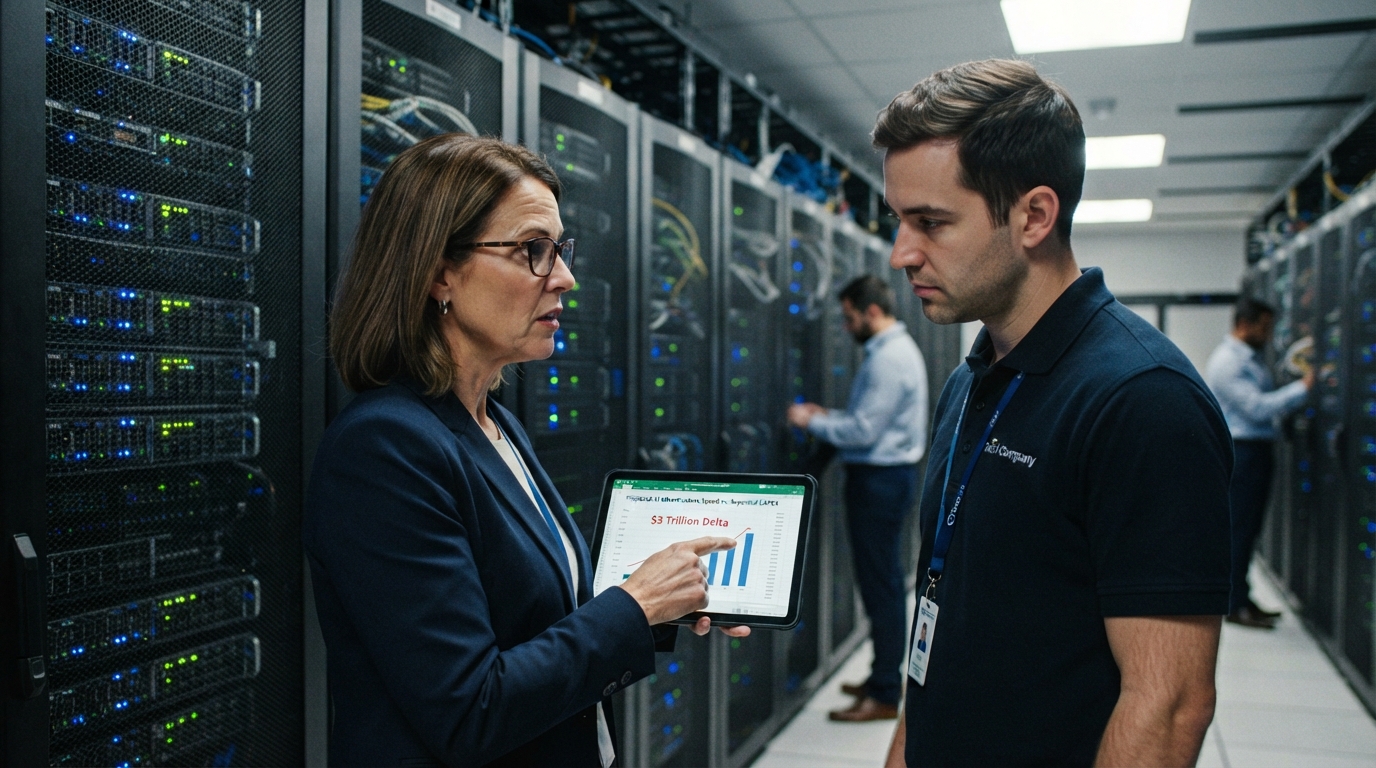
The artificial intelligence boom may involve significantly more spending than the headline capital-expenditure numbers suggest.
A new analysis by The Wall Street Journal estimates that nine major technology companies — including Alphabet, Amazon, Meta, Microsoft and Nvidia — have around $3 trillion in off-balance-sheet commitments, much of them connected to AI infrastructure. These commitments include future data-centre leases, long-term hardware purchases and other contractual obligations.
The story isn't that Big Tech has already spent $3 trillion on AI. It is that the companies have made commitments that could eventually require spending on a scale far beyond what their current capital-expenditure figures show.
The visible AI spending is only part of the picture
Amazon, Alphabet, Microsoft and Meta alone are expected to spend more than $600 billion on capital expenditure in 2026, with AI and data-centre infrastructure accounting for much of that investment. But capital expenditure is only one part of the financial commitment: companies can also sign agreements to lease future data centres or purchase equipment over several years, and those obligations can exist before the associated assets and payments appear in conventional balance-sheet measures.
What does "off balance sheet" mean?
An off-balance-sheet commitment isn't necessarily hidden or improper. Accounting rules determine when certain future obligations are recognised as assets, liabilities or expenses. A company can commit to a future data-centre lease today even though the lease has not yet begun.
The WSJ analysis found that the nine companies it examined had approximately $1.2 trillion in obligations from leases that had not yet begun, alongside approximately $1.9 trillion in long-term purchase commitments.
Meta provides a good example
Meta has committed to an initial $12.3 billion lease associated with its planned Hyperion data-centre project. Its total obligations for leases that had not yet begun were reported at approximately $347 billion as of June — future contractual commitments rather than money being paid today.
Why are technology companies making these commitments?
AI requires enormous physical infrastructure. Advanced models need GPUs and AI accelerators, data centres, networking equipment, storage, cooling systems, electricity, land and buildings, and fibre connectivity — and those requirements are growing as AI moves beyond chatbots into coding agents, enterprise automation and autonomous workflows.
A chatbot may make one model request. An AI agent performing a complex business process can make many requests, use several tools and operate continuously. That creates a much larger demand for computing capacity.
The AI infrastructure race
Nvidia CEO Jensen Huang has previously estimated that between $3 trillion and $4 trillion could be spent on AI infrastructure by the end of the decade. Gartner estimates global AI spending could reach approximately $2.59 trillion in 2026, up 47% from the previous year, with AI infrastructure representing more than 45% of the market.
What happens if AI demand doesn't meet expectations?
The entire investment thesis depends on continued growth in demand. If demand grows more slowly, a company could end up with underutilised data centres, unused computing capacity, long-term lease obligations, excess hardware commitments and higher depreciation and operating costs.
- Underutilised data centres and unused computing capacity
- Long-term lease obligations that continue regardless of demand
- Excess hardware commitments
- Higher depreciation and operating costs
AI spending is also changing corporate finance
Research submitted to the U.S. Senate Banking Committee in June estimated that major technology companies could spend close to $3 trillion through 2028, while generating only about half that amount in cash from operations over the period, alongside substantially higher debt issuance. The AI boom is increasingly becoming a capital-markets story: AI companies don't just need engineers, they need investors, lenders, private-credit funds, infrastructure financiers and energy developers.
Nvidia recently partnered with institutions including BlackRock, Blackstone, Brookfield, Apollo, Goldman Sachs and KKR on financing platforms designed to attract more than $500 billion in third-party capital for AI infrastructure, with Nvidia saying it could potentially provide up to $125 billion in backstop financing.
Electricity is becoming a critical AI resource
AI data centres require large amounts of electricity, and new facilities can require dedicated grid connections and substantial power-generation capacity. A 2026 filing with the Federal Energy Regulatory Commission noted that five major hyperscalers had announced more than $600 billion of capital expenditure for 2026. AI policy is increasingly becoming energy policy as well.
Will AI pay for itself?
AI is already contributing to revenue growth in cloud computing, advertising, software development and enterprise services. The key issue isn't whether AI creates economic value — it almost certainly does — but whether that value will be large enough and arrive quickly enough to justify the infrastructure being built today. Goldman Sachs economists recently estimated AI investment would reach about $600 billion in the United States in 2026, roughly 2% of GDP.
What this means for businesses
Most businesses won't see the $3 trillion in commitments directly, but they will experience their effects through the technology services they use: more powerful models, more AI applications, greater cloud capacity, better AI agents and potentially lower AI costs over time. For SMEs, the advantage is that they don't need to build any of this infrastructure themselves.
There is a caution too. The cost of AI services depends partly on the economics of the infrastructure underneath them, which can influence API pricing, cloud pricing, service availability and subscription prices. Businesses adopting AI should avoid designing critical processes around a single provider without considering alternatives and exit options.
What could this mean for Kenya and Africa?
The global buildout could benefit African businesses even though most of the physical investment is happening elsewhere. A Kenyan startup can use a sophisticated AI model without owning a single GPU, a retailer can deploy AI customer support, and a financial company can use AI for document processing. But countries that rely entirely on foreign infrastructure may remain dependent on international providers, which makes investment in regional data centres, connectivity, reliable electricity, cybersecurity and technical skills increasingly important.
Our take
The most important figure in the WSJ analysis isn't necessarily $3 trillion. It is the gap between what investors can currently see and what companies have already committed to spending. The AI economy is being built years ahead of the revenue it is expected to generate — an extraordinary opportunity if demand keeps rising, and a significant financial risk if it does not.
Sources: Wall Street Journal analysis of Big Tech's off-balance-sheet AI commitments; Reuters reporting on hyperscaler capital expenditure; Gartner's 2026 AI spending forecast; U.S. regulatory and congressional materials on AI infrastructure financing; and related industry analysis.
Tech briefing
Get the week's most important AI, automation, and technology news in your inbox.
Comments
No comments yet — be the first to share your thoughts.