
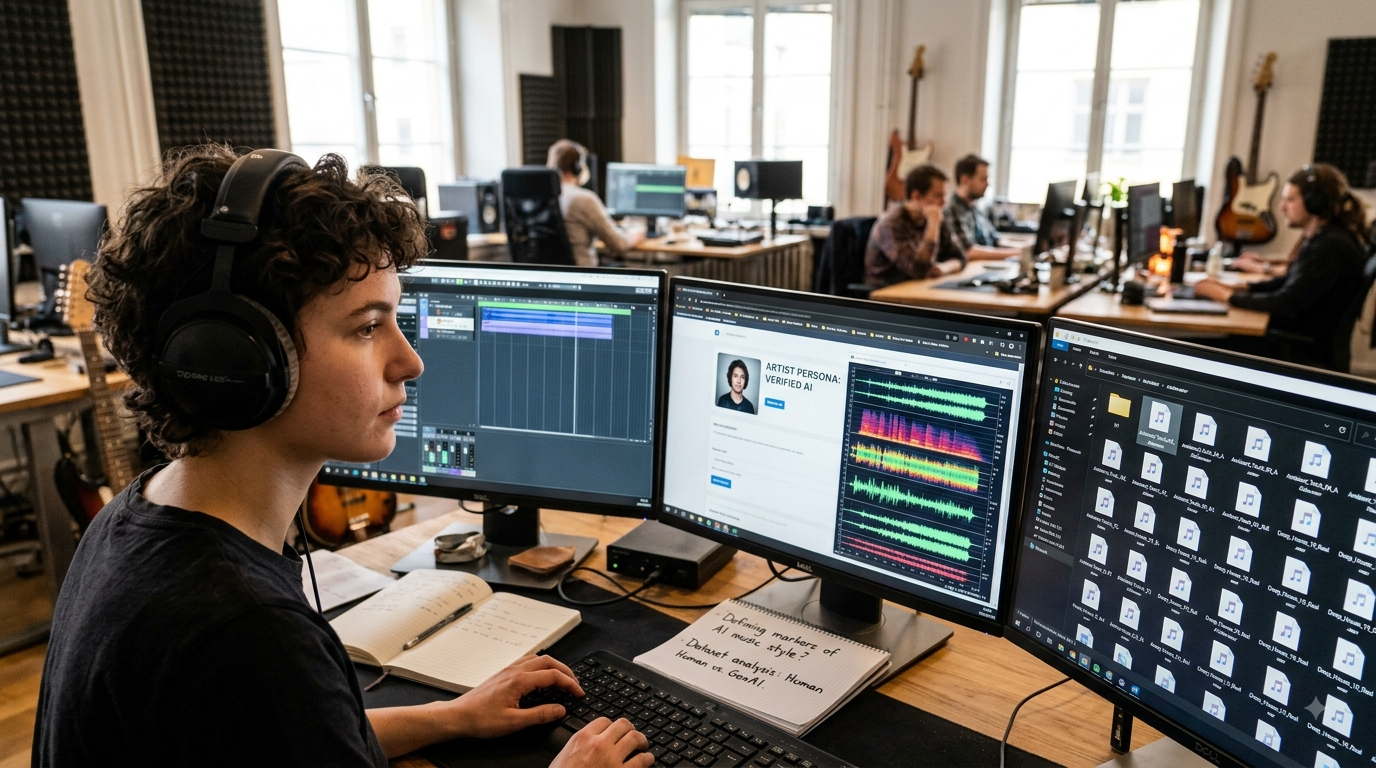
Spotify is preparing to introduce a new “AI Persona” label for artist profiles that use artificial intelligence to create a fictional performer identity.
The change, expected to begin rolling out in mid-September 2026, is designed to make it easier for listeners to distinguish between real human artists and fictional or AI-generated personas. Spotify also plans to keep identified AI Personas out of its editorial and algorithmic recommendations by default.
The move is an important step toward greater transparency. But it leaves a much harder question unresolved: what happens when the artist is real, but the music is partly or largely generated by AI?
Spotify is targeting artist identity, not AI music itself
A fictional artist created entirely through AI could receive an AI Persona label. A genuine human musician who uses AI tools during production would not automatically receive that label. That distinction matters because AI is increasingly used at different stages of production — lyrics, vocals, instrumentation, mastering — and those are very different creative processes.
Spotify already has AI Credits
Spotify's AI Credits feature allows artists and distributors to identify where AI was used in a track, including lyrics, vocals, instrumental performances and production. However, the system is in beta and the credits are optional. Spotify explicitly notes that the absence of an AI credit does not necessarily mean AI was not used.
That creates a transparency gap. A listener may know that an artist is a real person, but still have no clear way to determine how extensively AI was involved in the song.
Self-declaration has an obvious weakness
Spotify says its new AI Persona system will not rely entirely on self-reporting. The company plans to use human review and AI-based signals to identify profiles that appear to represent artificial identities, allow listeners to flag suspicious profiles, and give artists an opportunity to appeal decisions. Detecting AI involvement in the music itself is considerably harder.
AI music is becoming difficult to detect
Research published in 2026 highlights why a simple “human or AI?” test may no longer be sufficient. Researchers working on the HAIM benchmark note that modern music production increasingly involves hybrid workflows in which humans and AI contribute different parts of the same track, and found weaknesses in current detection approaches when AI-generated material is altered or combined with human recordings.
- Song A: written, performed and produced entirely by humans.
- Song B: written by a human, with AI helping during mastering.
- Song C: human vocals combined with AI-generated instrumentation.
- Song D: entirely generated by AI and released under a fictional artist identity.
A single label cannot meaningfully describe all four. That is why role-specific AI credits could eventually be more useful than a simple “AI-generated” badge.
Why Spotify is acting now
Spotify said in September 2025 that it had removed more than 75 million spammy tracks over the preceding 12 months, as generative AI made it easier to produce huge quantities of low-effort content and exploit streaming systems. The problem included mass uploads, duplicates and artificially short tracks.
A 2026 academic study examining AI music on Spotify reported that 93% of the AI music studied received few or no plays, evidence of “spray and pray” behaviour. The issue is not simply that there is more music — it is that the cost of generating music has fallen dramatically.
Recommendations could matter more than labels
Spotify's decision to keep AI Personas out of editorial and algorithmic recommendations by default may ultimately be more significant than the visible badge. A label tells the listener what they are hearing; recommendation rules determine what the listener hears in the first place.
That creates a new economic distinction: AI-created music may be allowed on the platform, but not necessarily given the same path to discovery.
Voice cloning makes the problem harder
Generative AI can reproduce a singer's voice, potentially creating the impression that an artist participated in a recording when they did not. Spotify has said its policies prohibit unauthorised impersonation and that it wants artists to control whether their voices are used in AI projects. Consent may ultimately matter more to artists than disclosure alone.
What this means for African artists
AI tools could lower the cost of music production for independent artists who previously struggled to afford studio time, backing musicians or professional production. A young artist in Kenya, Nigeria, Ghana or South Africa could use AI as part of the creative process without a large budget.
But the same tools make it easier for anonymous accounts to produce enormous quantities of synthetic music. The challenge is ensuring AI reduces barriers to legitimate creativity without making it harder for genuine artists to be discovered.
Our take
Knowing that an artist is synthetic is different from knowing how the music itself was created. The future of AI transparency in music probably needs a provenance system showing who created the work, which AI tools were used, which parts were AI-generated, whether voices were synthetic, and whether the artist consented.
The question is no longer simply “is this song AI-generated?” It is “what exactly did the AI do — and who should get credit, control and compensation for the result?”
Sources: Spotify's official AI policy and AI Credits documentation, Reuters reporting on the new AI Persona labels, and 2026 academic research into AI-generated music and detection.
Tech briefing
Get the week's most important AI, automation, and technology news in your inbox.
Comments
No comments yet — be the first to share your thoughts.