
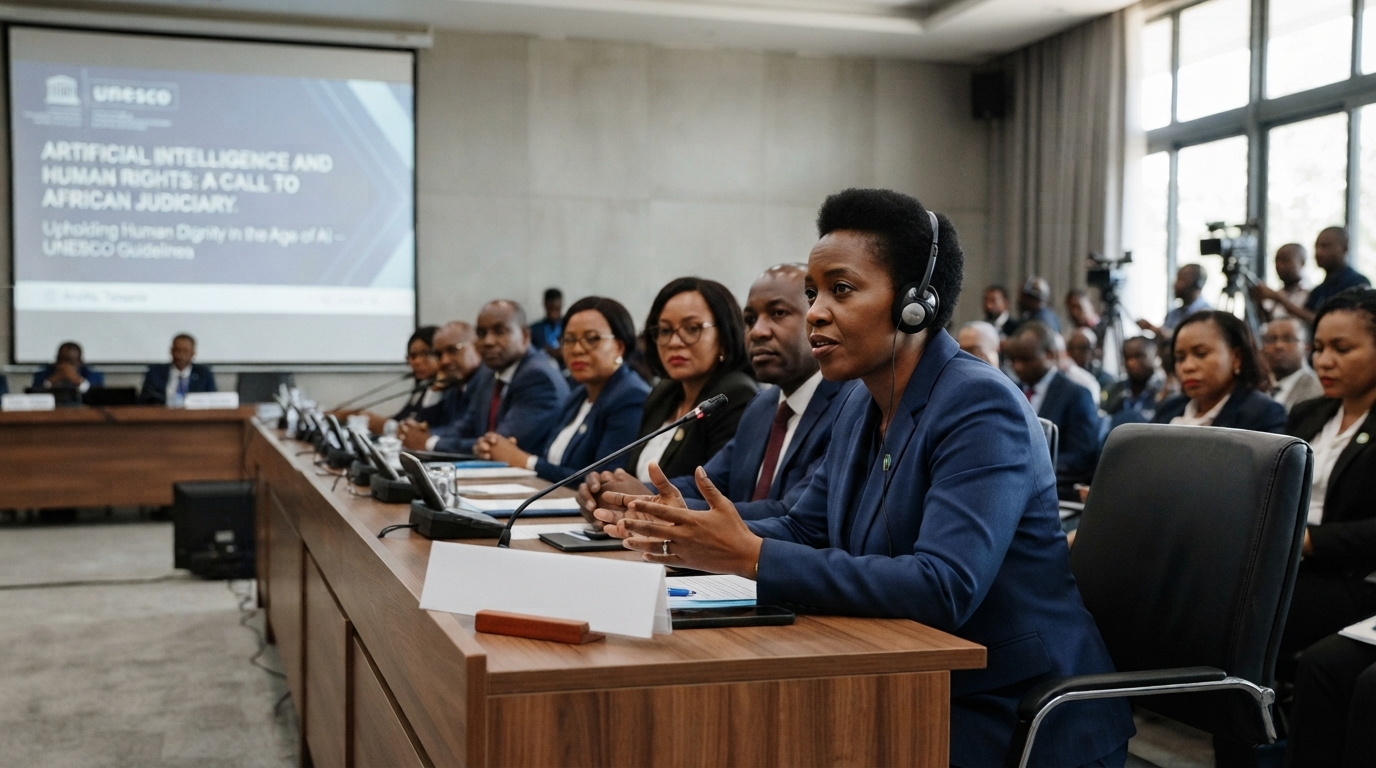
Artificial intelligence is beginning to change how courts and legal institutions work across Africa — from case management and evidence analysis to legal research and digital services.
But as AI becomes part of judicial systems, UNESCO is warning that technological efficiency cannot come at the expense of human rights, equality and judicial accountability. In a report published on 13 August 2026, the organisation highlighted efforts to promote a rights-based approach to AI across African judiciaries, with particular attention to gender equality and the rights of women.
AI is already entering African court systems
The debate is no longer theoretical. AI is already being explored or deployed for legal research, document analysis, transcription, evidence processing and case management. In Kenya, AI and digital tools have been discussed in the context of legal translation and accessibility services, while UNESCO's wider judicial programmes have examined algorithmic transparency and accountability.
The benefits can be significant: a court handling thousands of documents could surface relevant information faster, and legal professionals could search large collections of legislation and past decisions far more efficiently. But speed is not the only consideration when technology supports justice.
The risk of reproducing existing bias
One of UNESCO's biggest concerns is that AI systems can reproduce biases contained in their training data. Historical records can carry patterns of discrimination, and a system that learns from that information without safeguards may present discriminatory patterns as apparently neutral recommendations.
That is especially serious in policing, risk assessment, employment, credit and judicial decision-making. UNESCO says judicial leaders should demand transparency about the data and systems behind AI tools and insist on meaningful human oversight.
Why gender equality is central to the discussion
UNESCO's latest initiative focuses specifically on the intersection between AI and women's rights. AI can help analyse information in gender-based violence cases and identify patterns, but poorly designed systems could embed historical gender bias into legal processes.
The issue is broader than court decisions. Generative AI is already being used to produce deepfakes, non-consensual sexual imagery and other technology-facilitated abuse that disproportionately affects women and girls — which means courts must understand how AI changes the nature of digital evidence and digital harm.
African judicial leaders are calling for human oversight
The issue was a major focus of the Second High-Level Meeting of Women Judicial Leaders of Africa, held in Johannesburg from 20 to 24 April 2026. More than 300 chief justices, presidents of constitutional courts and other senior judicial leaders took part, with UNESCO acting as knowledge partner for the session on "Artificial Intelligence, the Digital Frontier and Women's Rights."
The meeting produced the Johannesburg Declaration, which calls for strong human oversight, transparency and accountability when AI is used in African judiciaries, alongside judicial education, digital literacy and survivor-centred digital justice tools.
Judges don't need to become AI engineers
Judicial readiness does not mean turning judges into technologists. It means judges knowing enough to ask the right questions:
- Where did the system's data come from, and how was it trained?
- Could the data contain bias?
- Can the result be independently verified?
- Can the affected person challenge AI-generated evidence or recommendations?
- Who is accountable if the system is wrong?
AI-generated evidence is a new challenge
Courts increasingly have to deal with material created or modified using AI: synthetic audio, deepfake video, altered photographs, AI-generated documents and automated analysis of digital evidence. The traditional question of authenticity becomes far harder when tools can generate realistic but fabricated material.
UNESCO says its Global Judges Initiative has trained more than 38,000 judicial operators in over 160 countries on responsible AI and the rule of law, and has published Guidelines for the Use of AI in Courts and Tribunals plus an online course developed with the University of Oxford, including a module on AI and women's rights.
What this could mean for Kenya
Kenya's legal and judicial institutions are already engaging with AI and digital transformation. The upside is considerable: lower administrative workloads, faster document analysis, better legal research and wider access to legal information. But adoption has to work within Kenya's constitutional and legal protections, which means pairing it with:
- Human oversight and clear accountability
- Data protection and strong cybersecurity
- Transparency and auditability
- Bias testing before and after deployment
- Accessible appeal mechanisms
The risk of "black box justice"
A person affected by a decision should be able to understand why it was made. That becomes much harder when an algorithm provides a recommendation without adequate explanation. A justice system cannot simply say "the AI said so" — the court remains accountable for the decision.
Courts will therefore need governance covering when AI may be used, who may use it, which systems are approved, what data may be entered, how AI-generated evidence is verified, how bias is tested and who is responsible when a system errs. These are questions of law and institutional accountability, not only technology.
Our take
AI could become one of the most useful technologies ever introduced into the justice system. But justice is different from other industries: a recommendation can affect someone's liberty, livelihood, family or safety. Accuracy alone is not enough — judicial AI must also be explainable, contestable and subject to meaningful human oversight.
For Kenya and the wider continent, the opportunity is to use AI to make justice more accessible and efficient while keeping technology subordinate to human dignity, equality and the rule of law. The real test is not whether AI can make courts faster. It is whether African judiciaries can use AI without reproducing the inequalities justice systems exist to overcome.
Sources
Tech briefing
Get the week's most important AI, automation, and technology news in your inbox.
Comments
No comments yet — be the first to share your thoughts.