
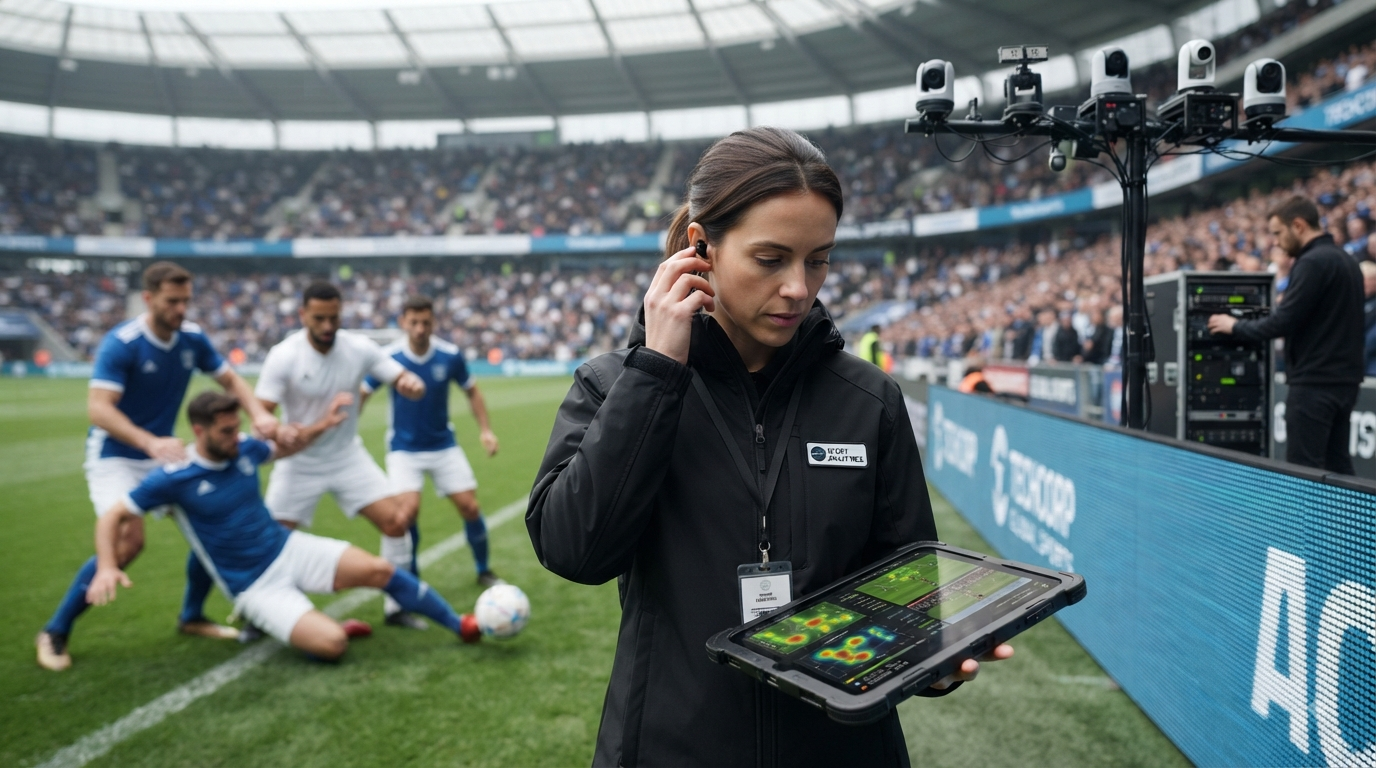
Artificial intelligence is transforming almost every industry, from software development and customer service to finance and healthcare. But football presents a particularly interesting challenge: the sport depends on something AI cannot easily manufacture — human unpredictability.
A player can produce an unexpected moment of brilliance. A goalkeeper can make an extraordinary save. A stadium can erupt because of something no algorithm predicted. That hasn't stopped technology companies and investors from seeing football as a major opportunity.
Football is already using AI
The idea that football is untouched by AI is already outdated. FIFA and Lenovo developed Football AI Pro, a generative AI assistant designed to give all 48 World Cup teams access to advanced match-analysis capabilities. The system analyses hundreds of millions of FIFA-owned football data points and can produce insights in text, video, graphs and 3D visualisations.
FIFA says the system is intended to give every participating team access to the same advanced analytical capabilities, potentially reducing some of the technological gap between richer and smaller football nations.
AI is also helping referees
For the 2026 World Cup, FIFA introduced advanced semi-automated offside technology alongside AI-enabled 3D player avatars. Players can be digitally scanned to create detailed 3D representations that support offside decisions and visual replays.
But there is an important distinction: AI assists the referee, it doesn't replace the referee. The technology identifies positional information and provides evidence, while human officials remain responsible for interpreting the situation and applying the laws of the game.
Even the football has become a data device
The official 2026 World Cup match ball includes Connected Ball Technology, with an inertial measurement unit capable of tracking the ball's movement and identifying the precise moment a player makes contact with it. The sensor works alongside stadium tracking systems and can transmit data in real time.
This is a good example of how AI doesn't need to be visible to change an industry. Fans simply see a football. Behind the scenes, it is generating data.
AI is changing the way fans watch
Modern sports audiences increasingly expect instant statistics, personalised content, highlights and multiple ways to follow matches. AI helps broadcasters process enormous amounts of video and data and turn them into useful content. FIFA's technology programme includes Referee View, player avatars and Football AI Pro.
But can AI replace the football experience?
AI can analyse a match, identify patterns, generate commentary, predict probabilities, create highlights and help referees. But football is not simply a collection of statistics. A team can dominate possession and lose. An underdog can beat a favourite. These human elements are precisely what make football difficult to automate completely.
AI can predict football — but not perfectly
Recent 2026 research has evaluated AI systems on the actual World Cup tournament, comparing predictions with real match results and betting-market benchmarks. One study found several frontier AI systems performed similarly to the betting market, while none clearly outperformed it. Another benchmark found only modest advantages over human and market baselines.
The investment opportunity may be bigger than the game
Technology investors don't need AI to replace football. They can make money by providing technology around football: sports analytics, broadcasting, ticketing, fan engagement, stadium technology, sponsorship, performance analysis, scouting, injury prevention, security, streaming and digital content.
What this means for African football
Advanced analytics have traditionally been expensive. A wealthy European club can employ large teams of analysts and data scientists; a smaller African club may have far fewer resources. If sophisticated analysis becomes available through cloud-based AI services, smaller clubs could gain capabilities that previously required large technical teams — in scouting, tactical analysis, training, performance monitoring, recruitment, fan engagement and content production.
Kenya could benefit from this shift
Kenyan football has a large potential audience but comparatively limited resources. A local club could use affordable AI tools to analyse match footage, create player-performance reports, generate social content and engage supporters. An academy could use computer vision to analyse technique. A broadcaster could use AI to generate multilingual content.
AI may actually make football more human
The more repetitive work AI performs, the more humans can focus on the parts of football that require judgment. An analyst spends less time collecting statistics, a coach less time preparing spreadsheets, a journalist less time transcribing. Those people can then spend more time on interpretation, storytelling, strategy and creativity.
Where AI should stop
Too much automation could make football feel sterile. If every decision is optimised by algorithm, teams could become more predictable. If every fan receives personalised content, the shared experience of a major tournament could fragment. Football's governing bodies face a balancing act: use technology to improve the game without allowing technology to become the game.
The bigger lesson for business
AI does not need to replace an entire industry to transform it. In football the pattern is data collection, analysis, decision support and fan engagement. In business it is customer enquiry, data processing, recommendation and action. The technology works best when it augments human decision-making and automates repetitive processes.
Our take
Football is unlikely to become completely AI-driven because its greatest asset is human unpredictability. But that doesn't make football AI-proof. The 2026 World Cup demonstrates that AI is already part of the sport's infrastructure.
The more interesting question is not whether AI will replace football, but how much of everything surrounding football AI can transform. The answer appears to be: quite a lot.
Sources: BBC Business, FIFA, FIFA Innovation, FIFA/Lenovo and recent research evaluating AI forecasting performance during the 2026 World Cup.
Tech briefing
Get the week's most important AI, automation, and technology news in your inbox.
Comments
No comments yet — be the first to share your thoughts.