
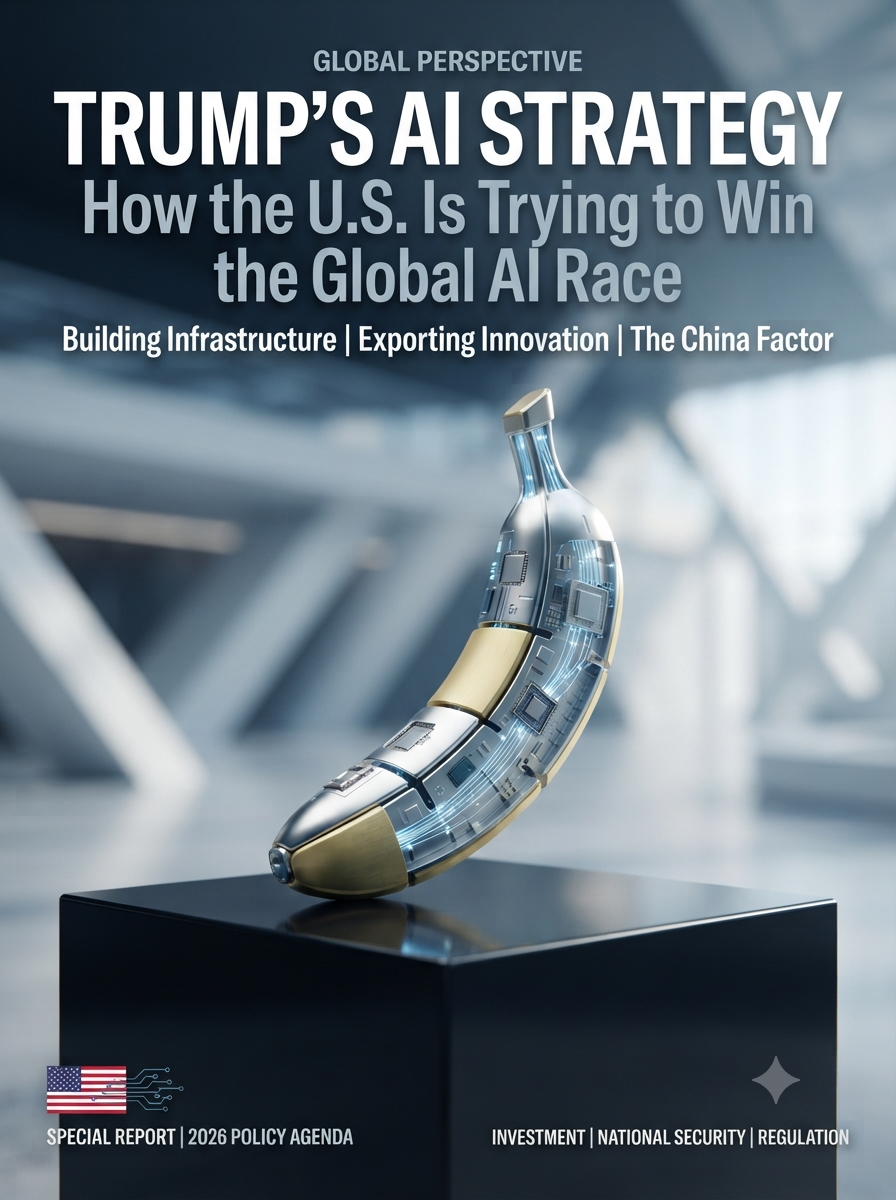
Artificial intelligence has become a major economic, technological and national-security priority for the United States, and the Trump administration has made maintaining American leadership in AI a central policy objective.
But the administration's approach is broader than simply supporting AI companies. Its strategy combines faster AI development, large-scale infrastructure investment, fewer regulatory barriers, AI exports, cybersecurity and national-security applications.
Since returning to office, President Donald Trump has issued a series of executive orders and policy initiatives aimed at strengthening the United States' position in the global AI competition.
The core objective: keep America ahead in AI
The strategy is built around the idea that artificial intelligence will influence economic competitiveness, national security and America's position in the global technology industry.
In January 2025, Trump signed an executive order directing the development of an AI Action Plan and reversing major elements of the previous administration's AI policy. The resulting America's AI Action Plan, released in July 2025, outlined more than 90 federal policy actions across three broad areas:
- Accelerating AI innovation
- Building AI infrastructure
- Expanding America's international AI leadership and security partnerships
These priorities continue to shape the administration's AI policy in 2026.
1. Building more AI infrastructure
Advanced AI models require enormous amounts of computing power, semiconductor capacity, data centers and electricity. The 2025 AI Action Plan called for faster construction of data centers and semiconductor facilities, including efforts to modernize permitting processes.
This is significant because the AI race is increasingly becoming an infrastructure race. Having the best AI models is not enough — countries also need the computing capacity, electricity generation, semiconductor supply chains and data-center infrastructure required to train and operate them. For businesses, this could ultimately affect the availability and cost of AI services around the world.
2. Promoting American AI exports
The administration wants American AI technology to become a major export. The Action Plan called for the United States to work with allies and partners to export full-stack AI systems — hardware, AI models, software, applications, cybersecurity systems and technical standards.
The objective is not simply to sell individual AI chips or software. It is to encourage countries to build their AI infrastructure around American technology, giving U.S. companies a larger global market while strengthening America's influence over the international AI ecosystem.
3. Reducing AI regulation
The White House has repeatedly argued that excessive regulation could slow American innovation and make it harder for U.S. companies to compete with China. The 2025 Action Plan called for removing regulations the administration believes unnecessarily restrict AI development and deployment.
In March 2026, the White House released a national AI legislative framework, arguing that a patchwork of conflicting state laws could undermine U.S. innovation. In December 2025, Trump signed an executive order aimed at preventing what the administration described as a fragmented state-by-state AI regulatory environment.
4. AI is becoming a national-security tool
In June 2026, Trump signed an executive order titled Promoting Advanced Artificial Intelligence Innovation and Security. It directs the federal government to strengthen cybersecurity using AI, protect government systems and critical infrastructure, and work with AI companies on security testing and advanced AI capabilities.
It also calls for a classified benchmarking process to evaluate the advanced cyber capabilities of frontier AI models. Importantly, the order states that it does not establish a mandatory government licensing or pre-clearance requirement for developing, publishing or distributing AI models.
5. The U.S. government wants to use more AI
In April 2025, the White House announced changes intended to remove barriers to federal AI adoption and encourage agencies to use American AI technologies to modernize government services. This effectively treats the U.S. government as both a regulator of AI and a major customer of AI technology — creating significant opportunities for companies providing government, cybersecurity, infrastructure and enterprise solutions.
6. AI and the military
In June 2026, Trump signed a National Security Presidential Memorandum directing the national-security enterprise to accelerate the adoption of advanced AI. The memorandum calls for rapidly bringing advanced AI models from multiple vendors into national-security applications and building high-security computing facilities capable of operating future AI systems at scale.
7. AI cybersecurity is becoming a major focus
The rapid development of autonomous AI agents has created new cybersecurity concerns. The June 2026 executive order directs federal authorities to prioritize enforcement against people who use AI to illegally access or damage computer systems, steal data or facilitate other crimes.
At the same time, the administration wants AI itself to become part of the defense against cyberattacks, calling for AI-enabled cybersecurity capabilities to be made available to federal agencies, state and local authorities and operators of critical infrastructure. AI is becoming both a cybersecurity threat and a cybersecurity defense.
8. The China factor
A major driver behind U.S. AI policy is competition with China. Washington is concerned that China could close the technological gap in advanced AI, semiconductor technology and computing infrastructure. Exporting American AI technology to allies is therefore about more than revenue — it can also help establish American technology as a global standard.
What about open-weight AI?
The AI industry increasingly includes both closed commercial models and open-weight models that developers can download and run themselves. The debate involves competing priorities:
- Innovation: open models can allow developers and businesses to experiment more freely.
- Security: more capable open models can potentially be adapted for harmful purposes.
- Competition: restricting access too heavily could push developers toward alternative AI ecosystems.
What could it mean for Kenya?
Kenyan businesses and government institutions are increasingly interested in AI for customer service, financial services, agriculture, education, healthcare, logistics and business automation. Much of that infrastructure comes from international technology companies, so changes in U.S. AI policy can indirectly affect Kenyan businesses through:
- AI model availability
- API pricing
- Cloud infrastructure
- Semiconductor supply
- Data-center investment
- Cybersecurity tools
- AI regulations
- International technology partnerships
If American companies continue exporting complete AI technology ecosystems, African businesses could gain access to increasingly sophisticated tools without building every component themselves. At the same time, governments and businesses will need to think carefully about data sovereignty, privacy, cybersecurity and dependence on foreign technology providers.
The bigger picture
Trump's AI strategy can be understood through five major objectives: build infrastructure, reduce barriers to innovation, secure AI systems, export American technology, and compete with China. These priorities are increasingly interconnected.
Our take
The most important part of the strategy may not be any individual executive order. It is the broader attempt to treat AI leadership as national infrastructure and economic policy, rather than simply as a technology-sector issue.
For businesses, this means AI policy is becoming difficult to separate from technology strategy. Companies choosing AI platforms, cloud services and automation systems should pay attention not only to what a model can do today, but also to who controls the underlying infrastructure, how the technology is regulated, and where data is processed.
For countries such as Kenya, the opportunity is to take advantage of increasingly capable AI tools while developing local skills, infrastructure, policies and businesses capable of participating in the AI economy. The global AI race is not simply about who builds the smartest model — it is about who builds the infrastructure, standards and ecosystems the rest of the world uses.
Sources: reporting from AI Magazine and additional verified information from the White House, including America's AI Action Plan, the June 2026 executive order on advanced AI innovation and security, the national AI legislative framework and the administration's national-security AI directives.
Tech briefing
Get the week's most important AI, automation, and technology news in your inbox.
Comments
No comments yet — be the first to share your thoughts.