
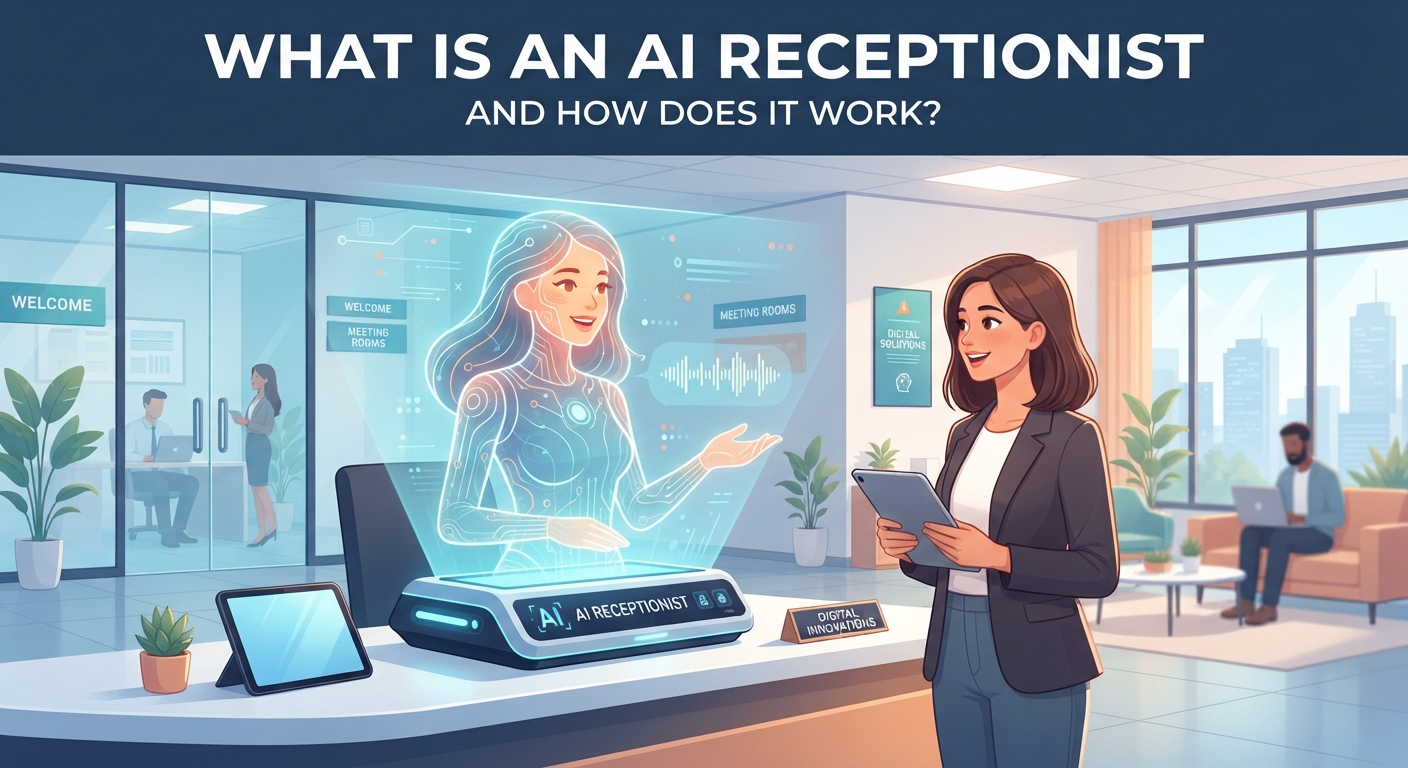
"An AI receptionist just plays a recorded message" isn't quite right. What is an AI receptionist? It's a voice AI system that answers business calls in real time, understands what the caller is asking, and takes action — booking an appointment, answering a question, or routing the call — without a human on the line. This matters for any Kenyan SME losing revenue to missed calls, not because the technology is novel, but because the business outcome (calls answered, jobs booked, staff freed from phone duty) is measurable from week one.
This article covers how an AI phone receptionist actually functions, who it suits and who it doesn't, what it costs to implement, and where a virtual AI receptionist beats — or loses to — a human hire.
Who this is actually for (and who it isn't)
A good fit if your business:
- Handles a steady volume of repetitive calls — booking inquiries, opening hours, pricing, availability
- Loses calls after hours, during lunch, or when staff are with a client
- Runs on appointment-driven operations — clinics, salons, gyms, law firms, hospitality, real estate viewings
- Already manages bookings in a CRM, calendar, or system that can be connected via automation
- Wants front-desk coverage without adding a full-time salaried role
A poor fit if your business:
- Handles mostly complex, judgment-heavy calls (contract negotiation, medical triage beyond basic scheduling, legal advice)
- Gets low call volume where a shared mobile line and a human are already sufficient
- Has no defined process for what happens after a booking is made — automating a broken process just breaks it faster
- Needs a receptionist for reasons beyond phone handling (walk-in management, mail, office admin)
Is an AI receptionist actually worth it for a small Kenyan business?
Cost concern is usually the real question hiding behind "how does this work," so it gets answered first. An AI phone receptionist doesn't have to replace a hire to be worth it — it has to answer calls a business is currently losing. A five-person clinic that misses ten calls a week during patient hours isn't losing ten calls; it's losing whatever a portion of those callers were willing to pay for an appointment, permanently, since most won't call back. Judging a virtual AI receptionist against "an employee's full salary" is the wrong comparison — the relevant comparison is against the calls currently going to voicemail or a busy line.
Pricing for AI receptionist systems is generally structured around setup plus a usage or subscription fee tied to call volume and integrations required. Exact figures vary by call volume, the complexity of the integrations (calendar, CRM, M-Pesa payment confirmation, WhatsApp handoff), and whether the business needs a fully custom build or a configured off-the-shelf platform. Any provider quoting a fixed number without first asking about call volume and existing systems is giving a marketing figure, not a business one.
What happens when a customer calls — isn't this just a chatbot with a voice?
No — a voice AI system built for phone calls is architecturally different from a text-based AI chatbot, even when both sit on similar underlying language models. A chatbot exchanges typed messages with pauses built in; a phone call has no pause tolerance — the system must transcribe speech, understand intent, and respond in near real time, on a channel where dead air reads as malfunction, not thoughtfulness.
When a customer calls, four things happen in sequence:
- Speech-to-text conversion. The system transcribes the caller's spoken words into text in real time.
- Intent recognition. The underlying AI agent interprets what the caller wants — booking, pricing, hours, a transfer request — from that transcript.
- Action execution. Depending on the intent, the system checks calendar availability, logs the request into a CRM, or triggers a workflow automation step (an SMS confirmation, a WhatsApp handoff, an email to staff).
- Text-to-speech response. The system converts its answer back into spoken audio and replies to the caller, continuing until the task is resolved or a human handoff is triggered.
This is the mechanism. The complexity isn't in any single step — it's in getting the handoff between steps fast enough that a caller doesn't notice the machinery. It also places the AI receptionist in a much older lineage of virtual assistant technology, now finally fast and accurate enough for live phone conversations.
What does implementation actually involve?
Implementation is a workflow-mapping exercise before it's a software one. Before any AI receptionist can answer a real call correctly, the underlying process — what questions get asked, what counts as a valid booking, what triggers a transfer to a human — has to be documented. Skipping this step is the single most common reason these systems underperform: the AI isn't wrong, the process it was configured against was never actually defined.
- A defined call-flow: common questions, booking rules, escalation triggers
- Integration with the business's existing calendar or CRM (HubSpot, GoHighLevel, or a custom system via Make.com or Zapier)
- A tested handoff path to a human for anything outside the AI's defined scope
- A review period where transcripts are checked against real call outcomes, not assumed accuracy
Exponential Automations builds this mapping and integration work directly — connecting the voice AI layer to a business's existing calendar, CRM, and messaging channels (including WhatsApp) rather than delivering a standalone tool the team has to wire in themselves.
AI receptionist vs. human receptionist vs. answering service
No option eliminates trade-offs — this table frames what a business gives up with each, not which one wins.
| Option | Best for | What you give up | Cost considerations |
|---|---|---|---|
| Human receptionist | Complex, high-touch calls needing judgment and relationship-building | 24/7 coverage; consistency across sick days, leave, turnover | Salary, benefits, training, and management overhead regardless of call volume |
| Third-party answering service | Overflow coverage without hiring | Deep familiarity with your specific business and systems; scripts are often generic | Per-call or per-minute fees that scale with volume |
| AI phone receptionist | High-volume, repetitive, appointment-driven calls, after-hours coverage | Nuanced judgment calls, emotional handling of sensitive calls, calls outside its defined scope | Setup cost plus usage-based fee; scales predictably with call volume once configured |
The realistic path for most Kenyan SMEs isn't full replacement — it's an AI receptionist handling the repetitive volume while a human takes what the AI correctly escalates.
Practical examples
A Nairobi-based dental clinic missing after-hours booking calls could route those calls to an AI receptionist that checks calendar availability and confirms appointments via SMS, with anything involving a medical concern escalated directly to staff the next morning. A boutique hotel in a tourist area could use a virtual AI receptionist to answer repetitive availability and pricing questions in English or Swahili, freeing front-desk staff for in-person guests. These are illustrative scenarios, not reported outcomes — actual results depend on call volume, process design, and how well the escalation rules are built.
What to avoid
- Automating a broken booking process. If staff currently double-book or lose paper booking slips, an AI receptionist will replicate that error at higher speed.
- Skipping the human handoff design. A caller with a complaint or an emergency routed into an endless AI loop damages trust faster than a missed call would have.
- Choosing a platform before mapping the call flow. Software selection should follow process definition, not precede it.
- Ignoring data handling obligations. Call recordings and transcripts containing personal data fall under the Kenya Data Protection Act's general obligations around consent and data handling; treat this as a compliance area requiring proper legal review, not an assumption.
- Measuring "calls handled" instead of bookings completed or revenue recovered. Activity metrics look good and mean little if the calls handled aren't converting.
Frequently asked questions
What is an AI receptionist, exactly?
How does an AI receptionist work on a technical level?
Is an AI phone receptionist expensive to set up for a small business?
Can an AI receptionist handle calls in both English and Swahili?
Will customers know they're talking to an AI, and does that matter?
What's the difference between an AI receptionist and a chatbot?
A note on AI search visibility
Businesses publishing content about their AI receptionist service can support how AI assistants like ChatGPT, Gemini, and Perplexity surface that information by using structured data — FAQPage, Service, and LocalBusiness schema markup in JSON-LD — alongside clear, direct answers in the page copy itself. Schema markup improves how machines parse a page; it doesn't guarantee inclusion in Google AI Overviews, Google AI Mode, or any AI assistant's response, since citation depends on multiple factors beyond markup alone.
Conclusion
An AI receptionist is a defined, workable system — not a vague promise of automation — that answers calls, interprets what a caller wants, and completes the booking or handoff a business actually needs, at a cost tied to real call volume rather than a flat salary. For Kenyan SMEs losing bookings to missed calls, the question isn't whether the technology works; it's whether the underlying process is defined well enough for the system to work against.
Not sure if your call volume and process actually justify this yet? Exponential Automations offers a free AI Readiness Snapshot — a direct look at where your business is losing calls, bookings, or leads, and whether an AI receptionist or a different fix solves it. Your business. Multiplied.
See where your business stands
Take the free AI Readiness Snapshot to find your biggest visibility gaps and the highest-impact opportunities for your business.
Comments
No comments yet — be the first to share your thoughts.