
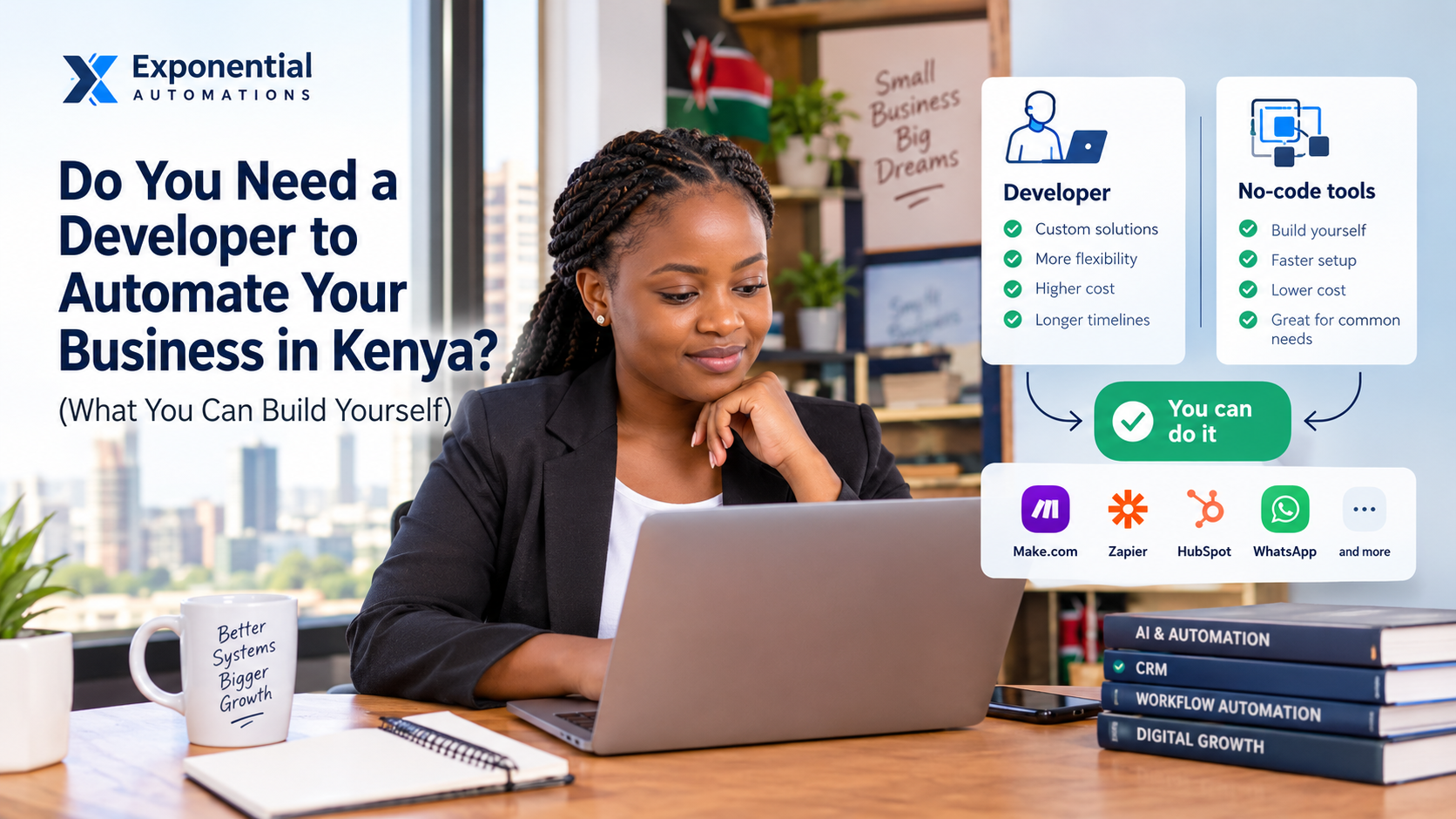
You do not always need a developer to automate your business in Kenya; many everyday workflows can be built with no-code tools. Picture a hypothetical salon in Kilimani managing appointments through WhatsApp, tracking payments in M-Pesa, and recording bookings in a Google Sheet. The owner spends time copying information between apps instead of serving clients. That is the kind of problem a simple automation can address without hiring a developer.
The real question is not whether you can automate your business yourself. It is whether the workflow is simple enough to build, reliable enough to trust, and worth the time you will spend maintaining it.
Here is what Kenyan SMEs can build independently, where AI automation becomes useful, and when working with an automation agency makes better business sense.
Do You Need a Developer to Automate Your Business in Kenya?
No, not for every automation. You can often automate repetitive, predictable tasks using no-code platforms such as Make.com and Zapier, provided the tools you use support the required integrations.
No-code automation connects applications through visual workflows. Instead of writing software from scratch, you define what should happen when an event occurs, what information should move between applications, and what action should follow.
For example, the hypothetical Kilimani salon could start with a straightforward workflow: when a client submits a booking form, the booking details are added to a Google Sheet and a confirmation message is prepared or sent through a supported messaging integration.
The owner does not necessarily need programming skills to create this process. The main requirements are a clear understanding of the booking procedure, access to the relevant accounts, and time to test the workflow.
However, no-code does not mean no technical thinking. Someone still needs to decide what triggers the automation, which information is required, what happens when a step fails, and who is responsible for resolving exceptions.
A useful distinction is that simple workflow automation usually does not require a developer, but complex integrations and custom systems may.
If your process requires several disconnected systems to exchange data, complicated business rules, custom APIs, or strict security controls, you may need technical implementation support. That could involve an automation specialist, an AI automation agency, or a software developer, depending on the requirements.
What Can You Build Yourself With No-Code Business Automation in Kenya?
You can build useful business automations yourself when the process follows consistent rules, the necessary applications already connect, and mistakes are easy to identify and correct.
For the hypothetical Kilimani salon, the best starting point is not an AI agent that manages the entire business. It is a small workflow that removes one recurring administrative task.
Appointment and lead management
A salon can collect bookings through a form, organize customer details in a spreadsheet, and notify the relevant staff member when a new appointment arrives. Depending on available integrations, it may also send a confirmation or reminder.
This is particularly useful when inquiries arrive through several channels and staff members manually transfer details into a booking register.
Customer follow-ups
A business can use automation to identify customers who need a follow-up and create reminders for staff. For example, after a completed appointment, the salon might create a task to request feedback or invite the customer to rebook.
Automated messages should follow the customer's communication preferences and applicable privacy requirements. The workflow should also make it clear when a person needs to respond instead of continuing an automated conversation.
Sales and CRM updates
Tools such as HubSpot and GoHighLevel can organize leads, track sales stages, and trigger supported actions when records change. A no-code workflow can often transfer information from a lead form into a CRM and notify the person responsible for follow-up.
This is useful for real estate agencies, gyms, professional services firms, and other SMEs that need to know who contacted them, what they requested, and what should happen next.
Internal notifications and reports
You can automate routine notifications, task creation, and basic reports when the source data is consistent. A business might receive a daily summary of new inquiries or a notification whenever a booking requires attention.
The salon could use this approach to review upcoming appointments and outstanding follow-ups without checking every conversation manually.
Basic AI-assisted tasks
AI tools can help classify inquiries, summarize messages, draft replies, and extract information from documents. These tasks can often be added to a no-code workflow, although the results still need appropriate checks.
For example, AI could categorize salon messages as booking requests, pricing questions, or complaints. Staff could then prioritize the messages that require a human response.
The important limitation is that AI can misunderstand requests or generate incorrect information. Keep human review where a mistake could affect a customer, payment, or business commitment.
What should you automate first?
Start with one repetitive task that has a clear beginning and end. Record how it currently works, estimate how much staff time it consumes, and identify the errors or delays it creates.
For the hypothetical salon, appointment administration may be a better first project than automating every customer conversation. It provides a defined process that the owner can test before expanding into reminders, customer follow-ups, or WhatsApp Automation.
A practical first automation should answer three questions: What triggers it? What should happen next? What happens if something goes wrong?
If those answers are unclear, document the process before building it.
DIY Automation vs. Hiring an Agency: What Changes for the Salon?
The choice depends on the salon's workflow, the consequences of errors, the integrations required, and the time available to maintain the system. DIY automation is often sensible for a small process; professional support becomes more valuable when the workflow spans several systems or affects revenue, customer experience, or sensitive information.
Consider how each option would work for the hypothetical Kilimani salon.
| Option | What changes for the salon | Advantages | Limitations | Cost considerations |
|---|---|---|---|---|
| Manual process | Staff continue moving bookings from WhatsApp into the spreadsheet by hand. | No setup or new software required. | Repeated admin, delayed responses, and potential recording errors. | Staff time and the cost of mistakes. |
| DIY no-code automation | The owner connects a booking form to the spreadsheet and configures notifications. | Low initial complexity and direct control over changes. | The owner must test, troubleshoot, and maintain the workflow. | Platform subscriptions, usage limits, and setup time. |
| Automation templates | The salon adapts an existing workflow template to its booking process. | Faster starting point when the template matches the process. | Unnecessary steps or unsupported integrations may need adjustment. | Template fees, platform costs, and customization. |
| Automation agency | A specialist maps the booking process, configures integrations, tests exceptions, and documents the system. | More structured implementation, testing, and support for connected workflows. | Requires clear requirements, a budget, and cooperation during implementation. | Scope, number of integrations, complexity, and ongoing support. |
| Custom software development | A developer builds functionality that existing tools cannot reasonably provide. | Greater control over specialized requirements. | More design, testing, maintenance, and development work. | Technical complexity, infrastructure, and long-term maintenance. |
For the salon, DIY may be sufficient if a standard booking form and spreadsheet solve the immediate problem. If the owner wants to connect WhatsApp inquiries, appointment availability, reminders, a CRM, and payment records, the implementation becomes more involved.
The key is to compare the full cost of each option, not just the price of the software. Time spent configuring a workflow, correcting failed runs, and keeping integrations working also has a cost.
When Should You Hire an Automation Agency Instead of Doing It Yourself?
Hire an automation agency when the workflow is business-critical, several systems must coordinate reliably, or maintaining the automation would take time away from running the business.
A capable implementation partner should do more than connect applications. The work should begin with process mapping, identify the required data and integrations, define how errors are handled, and establish how the business will monitor the result.
For the hypothetical Kilimani salon, professional help could become worthwhile if the owner wants to connect the booking process to a CRM, automate permitted WhatsApp communications, reconcile payment records against bookings, and route customer complaints to staff.
That system requires more than a basic trigger and action. Payment references must be matched correctly, duplicate records must be considered, and exceptions must not disappear without notice. Where M-Pesa integration is needed, the exact implementation depends on the payment service, available API access, and the salon's existing setup.
This is where an automation agency can assess whether no-code tools are sufficient or whether a custom integration is justified.
Exponential Automations helps businesses implement Workflow Automation, CRM Automation, WhatsApp Automation, AI Chatbots, AI Receptionists, and Custom AI Systems. The appropriate solution depends on the process, available integrations, data sensitivity, and the business outcome being targeted.
Before selecting a provider, ask how the team will test the workflow, handle failed actions, protect access credentials, document the implementation, and support future changes. Ask to see a clear scope of work rather than accepting a broad promise to automate the business.
How do you evaluate whether automation is worth the investment?
Measure the current process before paying for a solution. Record the time spent on repetitive tasks, how often errors occur, how long customers wait for responses, and how many follow-ups are missed.
Then compare those observations with the proposed workflow. Consider implementation costs, platform subscriptions, maintenance, staff training, and the value of the time recovered.
For the salon, the goal might be to reduce repeated booking administration and ensure inquiries reach the right person faster. Those benefits should be measured after implementation rather than assumed in advance.
Automation has a stronger business case when it improves a recurring process and the resulting time savings, reduced errors, or better follow-up justify its total cost.
What to Avoid When Building Business Automations
The biggest risk is not choosing the wrong automation platform. It is automating a process that has not been clearly defined.
The hypothetical salon should watch for four common mistakes.
Automating a broken process. If staff use inconsistent booking formats or fail to record appointment changes, automation may simply move incorrect information faster. Agree on a standard process and required fields before connecting the tools.
Ignoring exceptions and human handoffs. A booking may be incomplete, a customer may change an appointment, or an integration may fail. The workflow should notify a responsible person, preserve enough information to investigate the issue, and provide a way to correct the record.
Overlooking privacy and access controls. Businesses processing personal information should consider the Kenya Data Protection Act when designing workflows. Collect only the information needed for the stated purpose, restrict access, review how vendors handle data, and establish appropriate retention practices. Seek professional advice where the business needs a legal assessment.
Building too much at once. Connecting booking, payments, marketing, CRM, and customer support in one project creates more dependencies to test. Start with one defined workflow, confirm that it works reliably, and expand only when the next improvement is justified.
A reliable automation should be understandable to the people who use it. Documentation, error notifications, access controls, and clear ownership matter just as much as the initial build.
Frequently Asked Questions About Business Automation in Kenya
Can I automate my business without coding in Kenya?
What is the easiest business automation to build yourself?
How much does business automation cost in Kenya?
When should a Kenyan SME hire an automation agency?
Can AI automate WhatsApp messages and customer service?
What does a business like the hypothetical Kilimani salon need to automate first?
Can SEO and AI Search Help Customers Discover Your Business?
Automation can improve internal operations, while SEO, AEO, and GEO help businesses present useful information to people searching online. They solve different problems, but both benefit from clear processes and accurate information.
For example, a salon or clinic website can explain services, locations, pricing policies, and booking procedures in language customers understand. Technical improvements such as good Core Web Vitals, descriptive page titles, and appropriate Schema Markup can support how search engines interpret a website.
Article schema and BreadcrumbList schema may clarify the structure of a blog post and its place on the site. Organization, LocalBusiness, or Service schema may also be relevant where the information accurately describes the business. Structured data does not guarantee rankings or citations in ChatGPT, Perplexity, Gemini, or Google AI Overviews.
For businesses considering both operational automation and online discovery, these initiatives can be evaluated separately and then coordinated around practical business goals.
Conclusion: Choose the Right Level of Automation for Your Business
You do not need a developer to automate your business in Kenya when a simple no-code workflow can solve the problem reliably. Start by identifying one repetitive task, define how it should work, and measure whether the improvement justifies the cost. When the process involves multiple integrations, payment records, sensitive data, or business-critical decisions, professional implementation can reduce the burden of building and maintaining it yourself.
Start with Exponential Automations' free AI Readiness Snapshot. It is an opportunity to identify where AI and workflow automation may provide practical value, which processes are suitable for a DIY approach, and where specialist support may be useful. You can also speak directly with our team to discuss your existing tools, workflow challenges, and the most sensible next step for your business.
Your business. Multiplied.
See where your business stands
Take the free AI Readiness Snapshot to find your biggest visibility gaps and the highest-impact opportunities for your business.
Comments
No comments yet — be the first to share your thoughts.