
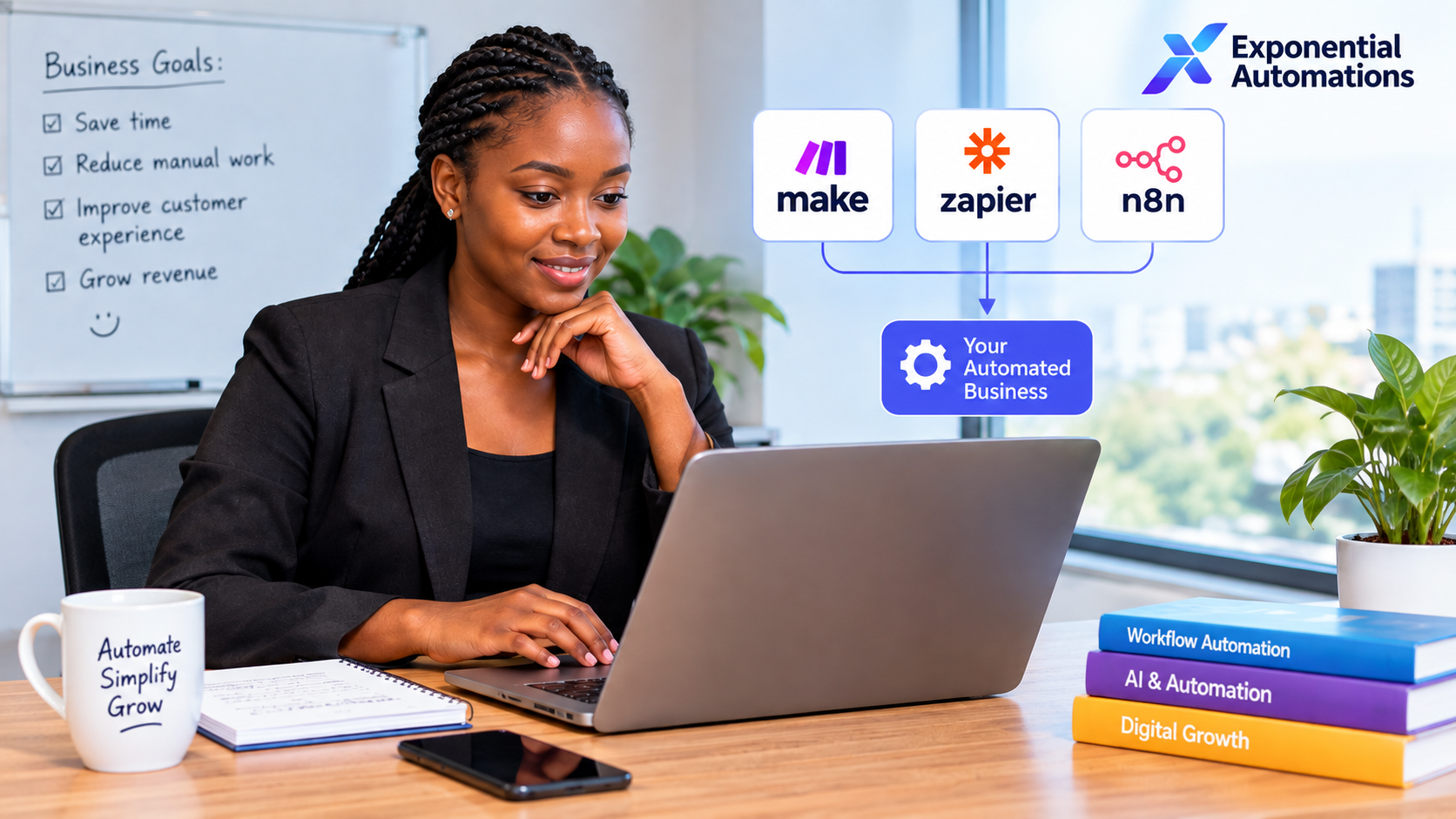
Choosing the right automation tool for SME Kenya operations comes down to three things: what you're connecting, who's maintaining it, and where your data needs to live — not which platform has the flashiest ad campaign. Picture a boutique salon and spa in Kilimani, three chairs, two therapists, a WhatsApp number the front desk answers between clients, and a Google Sheet that tracks bookings, product stock, and M-Pesa payments all at once. That's the gap workflow automation closes, and which tool closes it best depends entirely on what's actually breaking.
This guide walks through how to choose a workflow automation tool without getting lost in feature comparisons that don't map to how a small Kenyan business actually operates. We'll use this hypothetical salon throughout — it's not a real client, just a composite of the operational patterns we see across appointment-driven SMEs in Nairobi.
How to Choose a Workflow Automation Tool
The right tool is the one that matches your technical comfort, your integration needs, and your budget for ongoing maintenance — in that order. Most owners start by asking "which platform is best," but the better first question is "who is going to build and fix this six months from now." That single answer eliminates most of the confusion between Zapier, Make, and n8n before you've even opened a pricing page.
For the Kilimani salon, the front desk isn't going to write code, and the owner doesn't have a developer on staff. That rules out anything requiring server management as a default choice, though it doesn't rule it out entirely — more on that below. What the salon needs is simple: when a WhatsApp booking comes in, it should land in the calendar, trigger a confirmation message, and update the spreadsheet the owner still checks every evening. That's three connected steps, a light trigger-and-action chain, which is exactly the shape no-code automation for small business tools were built to handle.
Before comparing platforms, it helps to be honest about three inputs: how many tools you're connecting (a CRM, WhatsApp, M-Pesa records, Google Sheets, maybe HubSpot or GoHighLevel down the line), how often those workflows will need changing, and whether anyone in the business can troubleshoot a broken automation without calling for help. Get those three answers right and the tool choice mostly answers itself.
Zapier vs Make vs n8n for Small Business
Zapier is the easiest to start with and the most expensive to scale; Make offers more control at a moderate learning curve; n8n gives you the most flexibility and lowest per-task cost but expects someone to own the technical setup. For the salon, this plays out concretely. A Zapier setup connecting WhatsApp, Google Calendar, and Sheets is fast to launch — the owner could plausibly get a basic version running in an afternoon — but task-based pricing adds up quickly once every booking, reminder, and stock update counts as a separate "zap" run.
Make.com handles the same workflow with visual, node-based scenarios that are more transparent about what's happening at each step, and it tends to be more cost-effective at moderate volume — which matters once the salon is processing several hundred bookings a month. n8n, meanwhile, can run the identical logic self-hosted, which appeals to businesses thinking about data residency or long-term cost control, but someone needs to maintain the server or a hosted instance. For a two-person front desk, that's rarely worth the trade-off unless a technical partner is managing it on their behalf.
None of the three is universally "better." Zapier suits simple, low-volume workflows where speed to launch matters most. Make suits growing SMEs with multiple connected tools and a need for visibility into each automation step. n8n suits businesses with in-house technical capacity, higher data-sensitivity requirements, or workflows complex enough that per-task pricing becomes unsustainable. We've covered the deeper technical trade-offs between the three platforms in a separate comparison; the summary here is enough to make an informed first decision.
What Changes for the Salon Under Each Option
| Option | What Changes for the Salon | Advantages | Limitations | Cost Considerations |
|---|---|---|---|---|
| Zapier | Fastest to launch; owner can build the first version without help | Simple interface, huge app library, quick wins | Costs scale fast with booking volume; limited logic for multi-step exceptions | Per-task pricing; can get expensive above a few hundred bookings/month |
| Make.com | Visual scenario builder shows each step; easier to hand off to a partner for edits | More affordable at moderate volume; better error visibility | Steeper learning curve than Zapier for a non-technical owner | Operation-based pricing; generally more efficient at scale |
| n8n | Can be self-hosted, keeping booking and payment data on infrastructure the salon controls | Lowest long-term cost at high volume; strong data control | Requires technical setup and maintenance; not realistic as a solo DIY project | Free if self-hosted (excluding server costs); hosted plans also available |
For a business like the Kilimani salon, Make.com is often the practical middle ground — enough power to handle WhatsApp, calendar, and M-Pesa reconciliation together, without requiring a developer on payroll. That said, the right answer still depends on volume and whether data residency is a genuine concern, which brings us to a subsection worth addressing directly.
Self-Hosted Automation Kenya Businesses Should Consider
Self-hosting matters most for Kenyan businesses handling sensitive client data — health records, financial details, or anything covered by the Kenya Data Protection Act — where keeping data on infrastructure you control reduces exposure. This is where n8n's self-hosted option becomes genuinely relevant rather than a technical curiosity. A clinic storing patient histories, or a financial services firm handling client statements, carries different compliance weight than a salon booking haircuts.
If the Kilimani salon only processes appointment and M-Pesa transaction data, third-party cloud tools are typically fine, provided the business understands what data each platform stores and for how long. This isn't legal advice — Kenya Data Protection Act compliance is nuanced, and a business with real sensitivity concerns should have that reviewed professionally. But operationally, self-hosted n8n gives more control at the cost of more setup, and that trade-off is worth naming honestly rather than assuming every business needs it.
The 2026 Shift Toward AI Agent Automation Tools
Every major platform is moving from simple trigger-action workflows toward AI agent automation tools that can make decisions within a process, not just execute fixed steps. This matters because a basic "if WhatsApp message, then add to calendar" workflow has been possible for years. What's newer is a workflow that reads an incoming WhatsApp message, understands whether it's a new booking, a reschedule, or a complaint, and routes it accordingly — without a human first sorting the message into a category.
For the salon, that shift looks like an AI receptionist handling first-contact WhatsApp messages: confirming availability, answering pricing questions, and only escalating to a human when something falls outside its scope. Zapier, Make, and n8n are all building AI agent and LLM-connected nodes into their platforms, which means the choice between them increasingly includes a question about how well each handles conversational, judgment-based steps — not just data movement between apps. This is also where the workflow starts overlapping with AI chatbots, voice AI, and CRM automation rather than staying a pure "connect app A to app B" exercise.
When to Hire a Workflow Automation Consultant vs DIY
DIY makes sense when the workflow is simple, low-stakes, and unlikely to change often; a workflow automation consultant earns their fee when multiple systems, exception handling, or business-critical processes are involved. The salon's basic booking-to-calendar flow is a reasonable DIY project. But the moment M-Pesa reconciliation, stock alerts, staff scheduling, and WhatsApp all need to talk to each other — and a missed sync means a double-booked chair or an unpaid invoice nobody notices until month-end — the calculus changes.
A workflow automation consultant Kenya businesses bring in at that stage isn't there to build something flashier. They're there to map the actual process first, so the automation reflects how the business really runs rather than how the owner assumes it runs, and to keep the system maintained as WhatsApp, M-Pesa, or the CRM change their APIs. This is where Exponential Automations typically gets involved: workflow automation, CRM automation, and lead automation builds that connect the tools an SME already uses, plus AI agents and AI receptionists where a conversational layer adds real value rather than complexity for its own sake.
What to Avoid
The Kilimani salon's owner, in this hypothetical, nearly made a few mistakes worth naming plainly. First, automating the booking process before fixing the fact that walk-ins and WhatsApp bookings used two different systems — automation makes a broken process faster, not better, so the underlying workflow needs to be sound first. Second, skipping a human handoff step: an automated WhatsApp confirmation is fine, but a client asking a nuanced question deserves a person, not a bot loop with no exit. Third, treating M-Pesa and client payment data casually, without checking what each connected tool stores or for how long, which is a Kenya Data Protection Act consideration worth taking seriously even for a small business. Fourth, choosing the cheapest tool without accounting for volume growth — a platform that's affordable at 50 bookings a month can become expensive at 500. Finally, building the automation and never revisiting it; WhatsApp Business API changes, M-Pesa integration updates, and CRM changes all mean a "set and forget" automation quietly breaks more often than owners expect.
Which is better for a small business: Zapier, Make, or n8n?
What's the difference between Zapier, Make.com, and n8n?
Is workflow automation worth it for a small business in Kenya?
How much does workflow automation cost?
Do I need a developer to set up Zapier, Make, or n8n?
When should I hire a workflow automation consultant instead of doing it myself?
For businesses evaluating structured content and schema strategy alongside their automation build, it's also worth noting that Article, FAQPage, and LocalBusiness schema markup (JSON-LD) can help search engines and AI assistants surface accurate information about the business — though schema alone doesn't guarantee rankings or AI citations; it supports well-structured, genuinely useful content rather than replacing it.
Conclusion
Choosing the right workflow automation tool for SME Kenya operations isn't about picking the platform with the most features — it's about matching the tool to your actual volume, technical capacity, and data needs, then keeping the system maintained as your business grows. Zapier, Make, and n8n can all solve the same booking-and-payment headache the Kilimani salon faces, but they solve it at different costs and with different long-term trade-offs. The businesses that get the most value are the ones who fix the underlying process first, choose deliberately rather than defaulting to the most-advertised option, and know when a workflow automation consultant is worth the investment. Automation should make a good process faster — not paper over a broken one.
Ready to see where automation would actually help your business? Our team offers a free AI Readiness Snapshot — a straightforward look at where manual admin is costing you time, and which workflows are worth automating first. If it's useful, we're happy to speak directly with our team about what implementation would look like for your business specifically. No pressure, no generic sales pitch — just a clear picture of where to start.
Your business. Multiplied.
See where your business stands
Take the free AI Readiness Snapshot to find your biggest visibility gaps and the highest-impact opportunities for your business.
Comments
No comments yet — be the first to share your thoughts.