
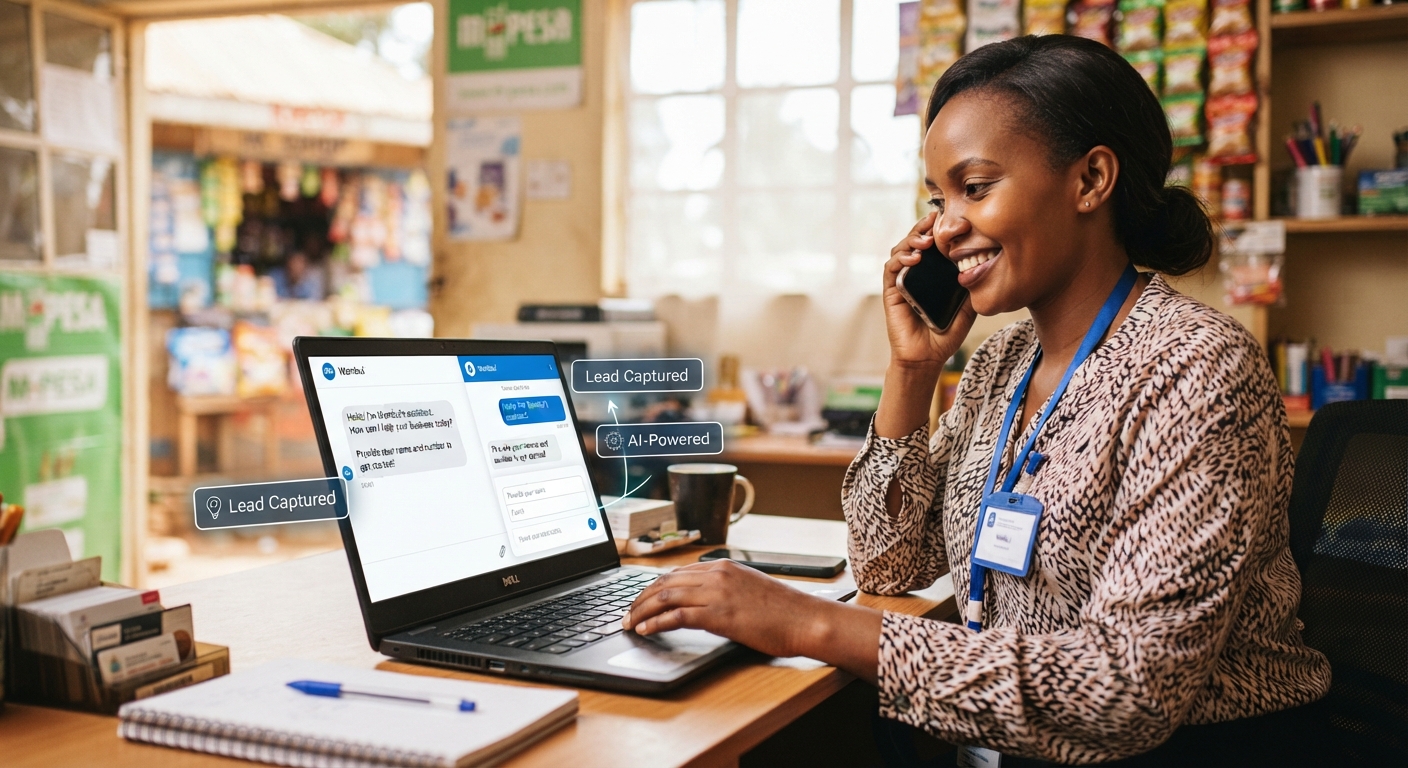
"A chatbot just answers FAQs" isn't quite right. An AI chatbot for SMEs in Kenya can qualify a visitor, capture their contact details, and route them to the right person before a human ever joins the conversation — turning a website visit that would otherwise leave no trace into a workable lead. This matters because most SME websites lose visitors who had a real question and no easy way to ask it outside business hours.
This article covers what a lead generation chatbot actually does, who it suits, what it costs to implement, how lead qualification works mechanically, and where a website chatbot in Kenya beats — or falls short of — a contact form or a human sales rep.
Who this is actually for (and who it isn't)
A good fit if your business:
- Gets steady website or WhatsApp traffic but low conversion into actual inquiries
- Sells a service or product with a definable qualification process (budget, location, timeline, service type)
- Operates with a small sales or admin team that can't respond to every inbound message immediately
- Runs in a sector where visitors ask repetitive pre-sale questions — real estate, clinics, gyms, salons, professional services, e-commerce
- Already has a CRM or spreadsheet-based lead list that a chatbot could feed directly
A poor fit if your business:
- Has very low website traffic — a chatbot has nothing to qualify if nobody's visiting
- Sells through relationship-heavy, high-touch sales cycles where early-stage automation reads as impersonal
- Has no defined follow-up process for captured leads — a chatbot generating leads that then sit untouched in an inbox solves nothing
- Needs the chatbot to close the sale outright rather than qualify and hand off
Can an AI chatbot actually generate more leads, or does it just chat?
A chatbot generates leads only when it's built to capture and qualify, not merely to answer questions. Generic FAQ bots that respond to "what are your hours" and stop there don't move a visitor toward becoming a lead — they just reduce email volume. A genuine lead generation chatbot asks qualifying questions in sequence, captures contact information at the right moment in the conversation, and pushes that data into a CRM or spreadsheet automatically, which is the difference between "conversation logged" and "lead captured."
Whether it increases lead volume for a specific business depends on current traffic and how many of those visitors are currently leaving without any way to express interest. A business with strong walk-in or phone-based inquiry channels and low website traffic will see a different impact than an e-commerce or real estate site where most first contact happens online. No credible source can respond with a specific percentage lift without seeing that business's actual traffic and current drop-off.
Is this worth the cost for a small Kenyan business, or is it overkill?
It's worth it only if the qualification logic is worth building — not simply because a chatbot is available cheaply. Setup cost generally scales with the complexity of the qualification flow and the number of systems it needs to connect to — a chatbot capturing a name, phone number, and general inquiry into a spreadsheet is a simpler build than one qualifying by budget, service type, and location before routing into a CRM pipeline.
The relevant cost comparison isn't chatbot cost versus zero cost — it's chatbot cost versus the value of the inquiries currently lost to unanswered late-night messages, a contact form nobody checks promptly, or a WhatsApp thread that goes unread for two days. A boutique law firm receiving a handful of high-value inquiries a month has a different cost-benefit case than a retail e-commerce site receiving hundreds of low-value browsing sessions daily.
How AI lead capture and chatbot qualification actually work
The mechanism has three stages: engagement, qualification, and handoff. This isn't a single "smart" step — it's a defined sequence that has to be configured correctly for lead quality to hold up.
- Engagement. The chatbot opens a conversation on the website or via WhatsApp, either proactively after a visitor spends time on a page, or when the visitor initiates contact.
- Qualification. The chatbot asks a defined set of questions — service interest, budget range, location, timeline — using natural language processing to interpret free-text answers, not just button clicks.
- Data capture and routing. Answers are logged into a CRM (HubSpot, GoHighLevel, or a custom system built via Make.com or Zapier) as a structured lead record, tagged by qualification criteria.
- Handoff. Qualified leads are routed to a human — by notification, task creation, or direct calendar booking — while unqualified visitors are given self-service information instead of consuming staff time.
That qualification logic and CRM connection is what separates a lead generation chatbot from a simple FAQ widget. Major platform vendors describe the same underlying architecture in their own AI chatbot use-case documentation — the chat interface is the smallest part of the build.
What implementation involves, and what affects the cost
Implementation starts with mapping the qualification criteria before any chatbot platform is chosen. A business has to define, in writing, what makes a lead worth a salesperson's time versus what doesn't — service type, budget floor, location served, urgency — before that logic can be built into a conversation flow. Skipping this step and picking software first is a common reason these projects underdeliver: the software works, but it was never told what a good lead looks like.
- Number of qualification questions and conditional branches in the conversation flow
- Integrations required (CRM, WhatsApp, calendar booking, email notification, M-Pesa payment confirmation for e-commerce use cases)
- Whether the chatbot needs to operate in English and Swahili, or handle mixed-language conversations
- Ongoing refinement based on real conversation data, since qualification logic is rarely correct on the first attempt
Exponential Automations builds the qualification logic and the CRM or WhatsApp connection as one system, rather than delivering a chatbot widget the business has to separately wire into its existing lead management process.
AI chatbot vs. contact form vs. human live chat
| Option | Best for | What you give up | Cost considerations |
|---|---|---|---|
| Contact form | Low-traffic sites, simple inquiries | Immediate response; most visitors abandon a form rather than wait for a reply | Minimal — often already built into the website |
| Human live chat | High-value, complex, relationship-driven sales | Availability outside working hours; consistency, since response quality varies by staff member and day | Staff time cost that scales directly with chat volume |
| AI lead generation chatbot | Repetitive qualification questions, after-hours capture, high-volume browsing sites | Nuanced judgment on ambiguous or emotionally sensitive inquiries; needs defined logic to perform well | Setup cost tied to qualification complexity, plus ongoing hosting or usage fees |
Most Kenyan SMEs get more value treating the chatbot as the qualification layer in front of a human closer, rather than expecting it to replace the sales conversation entirely.
Practical examples
A Nairobi-based real estate agency could use a website chatbot to ask visitors their budget range, preferred area, and purchase timeline before routing serious inquiries directly to an agent's CRM record, while browsing visitors get a self-service property list. An online retailer could deploy an AI chatbot to answer product availability questions and confirm order status, escalating only refund or complaint conversations to a human. These are illustrative scenarios to show how qualification logic changes by business type, not reported results from a specific client.
What to avoid
- Deploying a chatbot before defining what a qualified lead looks like. The conversation flow can only be as good as the qualification criteria behind it.
- Treating captured leads as the finish line. A chatbot generating leads that then sit unreviewed in a CRM produces activity, not revenue.
- Skipping the human handoff path. A visitor with a complex or urgent question stuck in an endless bot loop damages trust more than a plain contact form would have.
- Ignoring data handling practices. Contact details and conversation data captured through a chatbot fall under general obligations in the Kenya Data Protection Act around consent and data storage.
- Measuring conversations started instead of qualified leads or bookings generated.
Frequently asked questions
Can an AI chatbot generate more leads for my business?
How can an SME use a chatbot to capture and qualify leads?
Is a lead generation chatbot expensive to set up for a small Kenyan business?
What's the difference between a chatbot and a contact form for lead capture?
Can a chatbot handle leads in both English and Swahili?
Does a chatbot replace the need for a salesperson?
A note on AI search visibility
Businesses publishing content about their chatbot or lead generation service can support how AI assistants such as ChatGPT, Gemini, and Perplexity surface that information by using schema markup — FAQPage, Service, and Organization schema in JSON-LD — alongside direct, clearly structured answers in the page itself. Structured data helps machines parse the content correctly; it doesn't guarantee inclusion in Google AI Overviews, Google AI Mode, or any specific AI assistant's response.
Conclusion
An AI chatbot for SMEs in Kenya generates leads only when its qualification logic reflects what the business actually needs from an inquiry — not simply by being present on a website. For Kenyan businesses losing inquiries to unanswered forms, unread WhatsApp messages, or after-hours traffic, the real question isn't whether chatbots work in general, but whether the qualification criteria and follow-up process are defined well enough for one to work here.
Not sure whether your current traffic and follow-up process justify this yet? Exponential Automations offers a free AI Readiness Snapshot — a direct look at where your website or WhatsApp inquiries are currently falling through. Your business. Multiplied.
See where your business stands
Take the free AI Readiness Snapshot to find your biggest visibility gaps and the highest-impact opportunities for your business.
Comments
No comments yet — be the first to share your thoughts.