
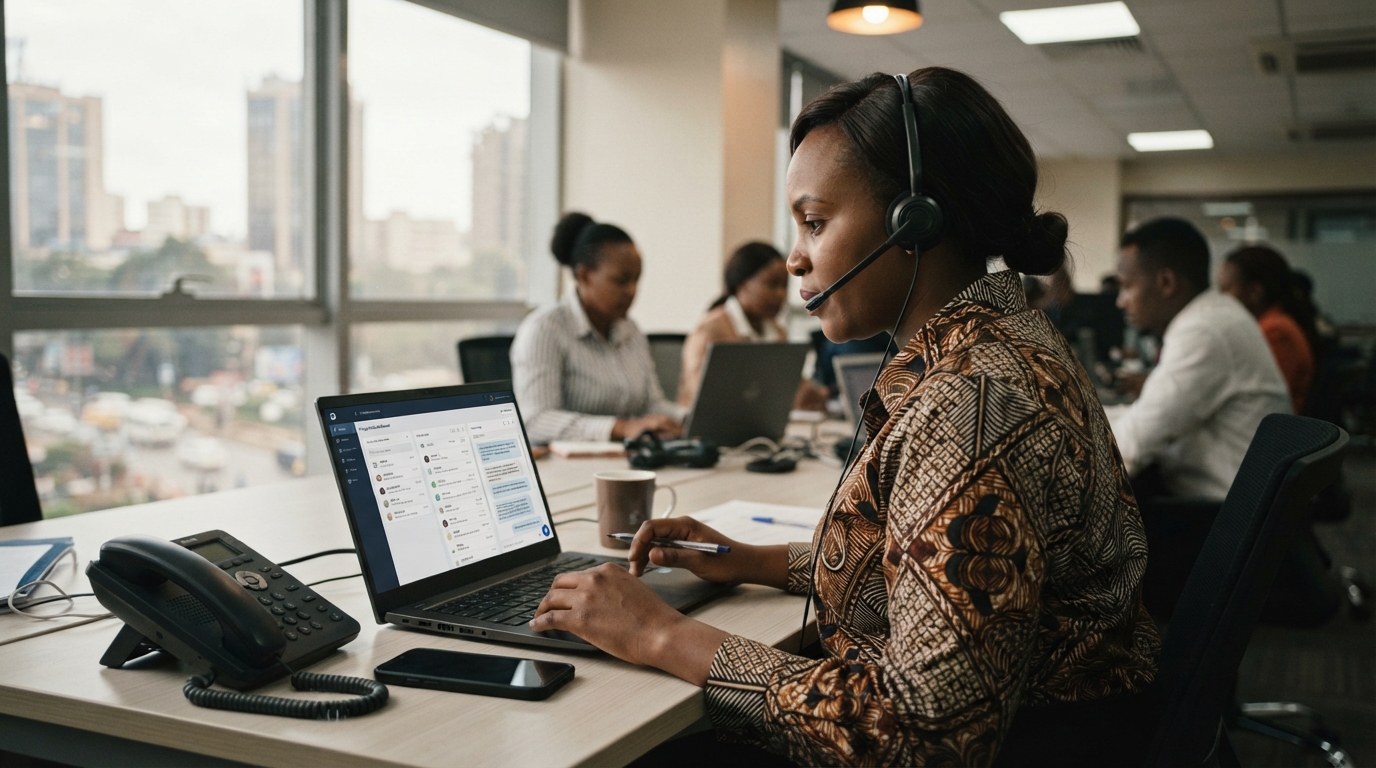
An AI receptionist Kenyan businesses can deploy today answers every incoming call, qualifies the caller, and books appointments without a human on the line. This matters because missed calls cost Kenyan SMEs real revenue. A caller who hears a busy tone or unanswered ring rarely calls back — they call the next business on the list.
This article explains what an AI receptionist does, how it works, what it costs to implement, and how it compares with alternatives like voicemail or a full-time receptionist. It also covers after-hours call answering, WhatsApp and CRM integration, and the practical steps to implement one in a Kenyan business.
What is an AI receptionist?
An AI receptionist is a voice-based AI system that answers business calls, handles routine questions, qualifies callers, and can book appointments or route calls to the right person. It runs on voice AI technology that understands spoken language, follows a script tailored to the business, and connects to backend systems like a calendar or CRM.
Unlike a simple voicemail system, an AI receptionist has a conversation. It can answer "What are your opening hours?", confirm availability for a property viewing, or take a caller's name and number for a callback. This distinguishes it from basic Interactive Voice Response (IVR) menus, which only route calls based on button presses.
For a Kenyan SME, the practical value is straightforward: no call goes unanswered, regardless of staff availability, time of day, or call volume.
The business problem: missed calls cost money
Every unanswered call is a business problem, not a minor inconvenience. A caller who reaches a dead line or endless ringing usually assumes the business is closed, unreliable, or too busy to serve them.
This is especially costly for appointment-driven businesses. A Nairobi clinic that misses a call during a busy morning may lose a patient who books elsewhere. A law firm that cannot answer during a client meeting may lose an intake that goes to a competitor instead. A salon juggling walk-ins and phone bookings often lets the phone ring out entirely.
Small teams are the most exposed. A business with two or three staff cannot dedicate one person to phones full-time and still run daily operations. The result is a pattern many Kenyan SME owners recognize: calls pile up during busy hours, and after-hours calls are lost completely.
How can I stop losing customers because nobody answers the phone?
The direct answer is to route every incoming call through an AI phone agent that answers instantly, every time, regardless of staff availability. This removes the dependency on a specific person being free to pick up the phone.
- Answer immediately. The system picks up on the first ring, so no caller hears a busy tone or unanswered ring.
- Qualify and respond. It asks relevant questions — service needed, preferred date, urgency — and gives direct answers to common queries like pricing ranges, location, or hours.
- Route or resolve. Simple requests are resolved on the call, such as booking an appointment. Complex requests are logged and routed to a staff member with full context already captured.
For a real estate agency in Nairobi, this means every call about a property listing gets a response, even during a busy showing schedule. The agent captures the caller's budget and preferred location, then either books a viewing or flags a qualified lead for the agent to call back.
Can AI answer business calls after hours?
Yes, an AI receptionist provides 24/7 coverage, including nights, weekends, and public holidays, without needing on-call staff. This is one of the more common reasons Kenyan SMEs adopt the technology.
After-hours call answering matters most for businesses where enquiries do not stop at 5 p.m. A hotel in Nairobi may receive booking calls from international travelers in different time zones. A clinic may get calls from patients seeking the next available appointment before they leave for work. A gym may get calls from prospective members in the evening, after regular staff have gone home.
An AI answering service handles these calls the same way it handles daytime calls: answering, qualifying, and either booking directly or logging a callback request for the morning. For businesses currently relying on voicemail after hours, the difference is significant — voicemail requires the caller to leave a message and wait, and many callers hang up instead.
What can an AI receptionist automate?
An AI receptionist can automate call answering, appointment booking, FAQ responses, lead qualification, and call routing. The specific automation depends on the business type and how its workflow is mapped.
- Booking and rescheduling appointments directly into a calendar.
- Answering repeated questions about hours, pricing, location, or services.
- Collecting caller details for follow-up, such as name, phone number, and reason for calling.
- Routing urgent calls to a specific staff member while logging routine calls for later review.
- Confirming appointments via a follow-up [WhatsApp automation](/services/ai-chatbots) message.
It does not replace judgment-based conversations. Complex complaints, sensitive client matters, or negotiations still need a human. A well-implemented AI receptionist recognizes these situations and hands off to staff rather than attempting to resolve everything itself.
AI receptionist vs. voicemail vs. full-time staff receptionist
| Option | Best for | Advantages | Limitations |
|---|---|---|---|
| Voicemail | Very low call volume, minimal budget | No ongoing cost, simple to set up | Most callers hang up rather than leave a message; no real-time resolution |
| Full-time staff receptionist | High-touch businesses needing in-person coordination | Personal touch, handles complex situations directly | Limited to working hours; salary and benefits cost; cannot scale during call spikes |
| AI receptionist | SMEs with appointment-driven or enquiry-heavy call volume | Answers every call, works 24/7, scales during busy periods, integrates with CRM and WhatsApp | Requires setup and workflow mapping; human handoff still needed for complex cases |
Many Kenyan SMEs use a hybrid approach: an AI receptionist handles first contact and routine bookings, while staff handle escalations and relationship-building conversations.
How does an AI receptionist compare with an AI chatbot?
An AI receptionist handles phone calls using voice AI, while an AI chatbot handles text-based conversations on a website or WhatsApp. Both qualify leads and answer routine questions, but they serve different channels.
Kenyan customers frequently move between channels — calling a business first, then following up on WhatsApp to confirm details. Because of this, an AI receptionist works best when connected to the same CRM and lead management system as any chatbot or WhatsApp automation the business uses. This keeps a single record of the customer regardless of how they made contact.
How do I implement an AI receptionist?
Implementation starts with mapping the existing call workflow before selecting any software. Skipping this step is the most common reason automation projects underperform.
- Map current call handling. Identify who answers calls now, what questions come up most often, and where calls are currently lost.
- Define the script and escalation rules. Decide what the AI receptionist should resolve directly and what it should route to a human.
- Connect integrations. Link the system to the business calendar, CRM, and WhatsApp so bookings and follow-ups happen without manual data entry.
- Test with real call scenarios. Run through common caller questions before going live, including ones in both English and Swahili where relevant.
- Review call logs regularly. Use the first few weeks of data to refine responses and catch gaps in the script.
A professional services firm, for example, might connect its AI receptionist to HubSpot or GoHighLevel so every call automatically creates or updates a client record, removing the need for manual entry into a spreadsheet.
What affects the cost of an AI receptionist?
Cost depends on call volume, the complexity of the workflow, and which systems it needs to integrate with. A business that only needs basic FAQ answering and appointment booking requires less setup than one needing multi-department call routing, M-Pesa integration for payment confirmations, or bilingual English-Swahili scripting.
Rather than quote a fixed price without context, the practical approach is to map the workflow first, since that determines the actual scope of work. Businesses evaluating providers should ask what is included in setup, what ongoing support looks like, and how changes to the script or routing rules are handled after launch.
Common mistakes to avoid
- Automating a broken process. If the current call-handling workflow is inconsistent, automating it will only make the inconsistency faster.
- Skipping human handoff planning. An AI receptionist without a clear escalation path frustrates callers with complex or sensitive requests.
- Ignoring integration with the CRM. A receptionist that captures leads but does not feed them into a CRM creates a second manual step that staff eventually stop doing.
- Treating it as "set and forget." Call scripts need periodic review based on real call logs, especially in the first few months.
- Overlooking data privacy. Apply practical safeguards consistent with the Kenya Data Protection Act, including limiting who can access call records and being clear with callers about how their information is used. Professional legal review is advisable here.
Is an AI receptionist worth it for a small business?
It is generally worth it for small businesses that lose calls during busy periods, after hours, or due to limited staff availability. The clearest signal is a business where phone enquiries directly convert into bookings or sales, since each missed call has a measurable cost.
Businesses with very low call volume, or where most contact already happens through WhatsApp or in person, may see less benefit from a dedicated AI receptionist and could prioritize chatbots or WhatsApp automation instead. The right starting point depends on where the business is actually losing enquiries, which is best identified through a workflow review rather than assumption.
Frequently asked questions
How can I stop losing customers because nobody answers the phone?
Can AI answer business calls after hours?
Does an AI receptionist work with WhatsApp?
Can an AI receptionist integrate with my CRM?
Is an AI answering service better than voicemail?
What are the risks or limitations of using an AI receptionist?
Conclusion
An AI receptionist solves a specific, measurable problem: calls that go unanswered during busy hours or after close. It answers every call, qualifies the caller, books appointments, and connects to the CRM and WhatsApp systems a business already uses, turning missed calls into captured leads.
A free AI Readiness Snapshot can show exactly where your business is losing calls and enquiries, and what an AI receptionist setup would look like for your workflow. Or speak directly with our team to review your current call handling.
See where your business stands
Take the free AI Readiness Snapshot to find your biggest visibility gaps and the highest-impact opportunities for your business.
Comments
No comments yet — be the first to share your thoughts.