
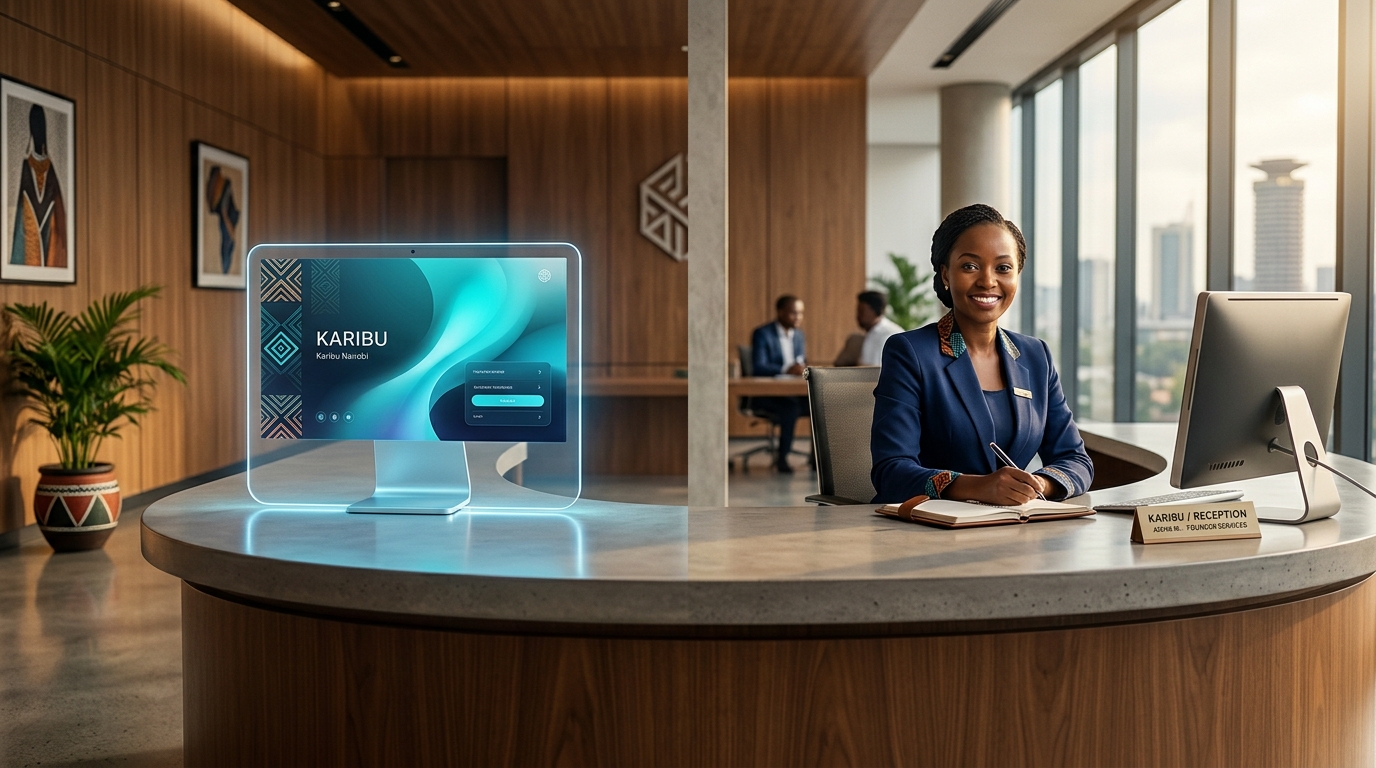
An AI receptionist vs human receptionist decision comes down to call volume, budget, and how much of the work is repetitive versus judgment-based, not which option is universally better. Many Kenyan SMEs default to hiring a human receptionist because it is familiar, without weighing whether an AI receptionist would handle the actual call patterns of the business more effectively. This article compares both options directly on cost, availability, call handling, and fit.
What is an AI receptionist?
An AI receptionist is a voice-based AI system that answers business calls, handles routine questions, qualifies callers, and can book appointments or route calls to the right person. It runs continuously, does not need breaks, and can handle multiple calls at the same time, which a single human receptionist cannot do.
A Kenyan clinic, for example, can use an AI receptionist to answer calls asking about appointment availability, opening hours, or basic service pricing, freeing front-desk staff to handle patients who are physically present. The AI receptionist can also collect patient details and forward urgent calls to a staff member immediately.
Should I hire a receptionist or use an AI receptionist?
The right choice depends on call volume, the complexity of typical calls, and budget, and many businesses benefit from using both rather than picking one exclusively. A human receptionist is generally the better fit when calls frequently require nuanced judgment, in-person coordination, or handling sensitive situations that need empathy and discretion, such as a law firm managing a distressed client.
An AI receptionist is generally the better fit when call volume is high, questions are repetitive, and the business needs coverage outside standard office hours. A hotel receiving guest enquiries at all hours about check-in times, room availability, or directions is a strong candidate, since a human receptionist cannot realistically staff a desk around the clock.
The strongest results for many Kenyan SMEs come from a hybrid model: an AI receptionist handles high-volume, repetitive calls and after-hours enquiries, while human staff handle complex conversations and in-person interactions during business hours.
Which is cheaper, an AI receptionist or a human receptionist?
An AI receptionist is typically less expensive to run on an ongoing basis than a full-time human receptionist, because it does not require a monthly salary, statutory benefits, or paid leave, though it does involve setup and maintenance costs. A human receptionist in Kenya carries recurring salary costs, NSSF and SHIF contributions, and the operational cost of training and replacing staff when they leave.
An AI receptionist instead involves an initial setup cost to configure call flows, integrations, and scripts, plus an ongoing platform or maintenance cost that is generally lower than a full-time salary. The exact cost depends on call volume, the number of integrations required, such as connecting to a CRM or booking calendar, and whether the business needs voice AI in English only or also in Swahili.
Cost should not be the only factor. A human receptionist provides judgment and relationship-building that an AI receptionist cannot fully replicate, particularly for high-value client interactions such as those in professional services or financial services firms.
AI receptionist vs human receptionist: direct comparison
| Factor | AI receptionist | Human receptionist |
|---|---|---|
| Availability | 24/7, including weekends and holidays | Limited to working hours and shifts |
| Call capacity | Handles multiple calls simultaneously | One call at a time |
| Cost structure | Setup cost plus ongoing platform fee | Monthly salary, statutory contributions, leave, training |
| Consistency | Follows the same script every time | Can vary with mood, fatigue, or experience |
| Complex or sensitive calls | Limited; best paired with human handoff | Strong; provides judgment and empathy |
| Best for | High call volume, repetitive questions, after-hours coverage | Sensitive conversations, in-person coordination, relationship management |
| Setup effort | Requires call-flow design and integration | Requires hiring, onboarding, and training |
What does an AI receptionist handle well?
An AI receptionist handles well-defined, repeatable call types most effectively, including appointment scheduling, opening hours, pricing questions, and basic qualification of new enquiries. Voice AI can also route urgent calls to the right staff member instead of leaving a caller on hold or sending them to voicemail.
A law firm can use an AI receptionist to answer initial client intake calls, capture the caller's basic legal issue and contact details, and schedule a consultation, while a lawyer handles the substantive conversation once the appointment is booked. An accounting firm during tax season can use one to handle a spike in calls asking about deadlines and document requirements, without hiring temporary front-desk staff for a few weeks a year.
What does a human receptionist handle better?
A human receptionist handles ambiguous, emotionally sensitive, or highly customized conversations better than an AI receptionist, because these situations depend on judgment that goes beyond a defined script. A healthcare front desk managing an anxious patient, or a hospitality front desk resolving a guest complaint in person, benefits from a person who can read the situation and respond flexibly.
A human receptionist also manages in-person tasks that a voice system cannot, such as greeting visitors, managing physical documents, or coordinating with staff face-to-face. For businesses where the front desk is a visible part of the customer experience, a human presence often matters for the impression it creates.
Can an AI receptionist work alongside a CRM?
Yes, an AI receptionist can integrate with a CRM so that call details, caller information, and booking outcomes are logged automatically instead of written down manually. This connects receptionist automation to broader CRM automation and lead management, so calls become trackable pipeline activity rather than isolated phone conversations.
For example, a real estate agency's AI receptionist can log every property enquiry directly into a CRM such as HubSpot or GoHighLevel, tagging the caller's interest and preferred follow-up time, so an agent has full context before calling back. Without this integration, receptionist calls, whether handled by AI or a person, risk becoming disconnected from the sales process.
Common mistakes when choosing between the two
Assuming AI must fully replace human staff creates unnecessary resistance and often a worse outcome. Most Kenyan SMEs get better results from a hybrid setup where AI handles volume and routine questions, and staff handle judgment calls and relationship-building.
Deploying an AI receptionist without a clear escalation path frustrates callers who need help the system cannot provide. Every configuration should include a defined point at which the call transfers to a human, particularly for complaints or urgent issues.
Choosing based on cost alone ignores call complexity. A business with low call volume but high-stakes conversations, such as a financial advisory firm, may not save meaningfully by replacing a receptionist with AI if most calls need human judgment anyway.
Failing to connect the receptionist, human or AI, to the CRM means enquiry data lives nowhere useful. This is a workflow gap regardless of who or what answers the phone.
Should I hire a receptionist or use an AI receptionist for my business in Kenya?
Which is cheaper, an AI receptionist or a human receptionist?
Can an AI receptionist handle Swahili and English calls?
Does an AI receptionist replace all front-desk staff?
Can an AI receptionist book appointments directly into a calendar?
Is an AI receptionist reliable for a small business with low call volume?
Conclusion
The AI receptionist vs human receptionist decision is not about replacing people with technology; it is about matching each option to the calls it handles best. An AI receptionist suits high-volume, repetitive, and after-hours calls at a lower ongoing cost, while a human receptionist suits sensitive, judgment-heavy, and in-person interactions. Most Kenyan SMEs get the strongest result from combining both.
See where your business stands
Take the free AI Readiness Snapshot to find your biggest visibility gaps and the highest-impact opportunities for your business.
Comments
No comments yet — be the first to share your thoughts.