
Introduction
A clinic manager or doctor in Nairobi's Westlands, Parklands, or South C knows the pattern well. The phones ring constantly during morning and evening peaks. Receptionists juggle calls while patients wait in a full room. Yet the next day's schedule still shows four or five empty slots. Patients forgot, could not reach anyone to confirm or reschedule easily, or simply moved on after a long hold or no answer after 6 pm. Each missed appointment represents lost revenue — the consultation fee plus any follow-on tests, procedures, or ongoing care — and adds pressure on an already stretched team.
At the same time, many patients now expect instant, professional responses whether they call or message on WhatsApp. Fragmented communication creates frustration on both sides.
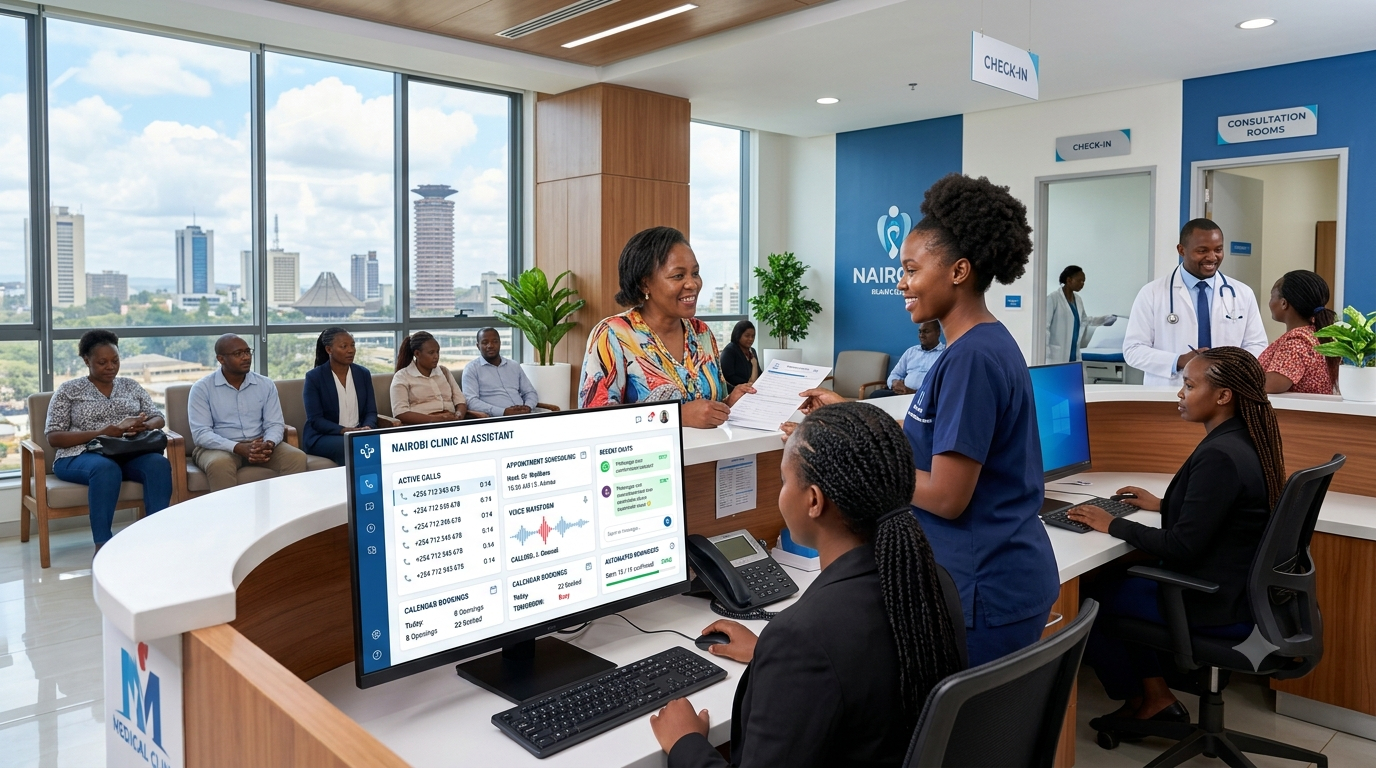
AI receptionist Kenya solutions — also called AI voice agents for clinics — are changing this reality for forward-thinking Nairobi healthcare providers. These intelligent systems answer calls 24/7, understand natural conversation in English and Swahili, book or reschedule appointments from your real-time calendar, answer common questions, send proactive reminders with easy reschedule options, and hand off complex matters to human staff seamlessly.
Clinics implementing them are seeing no-show rates drop 20–40%, recovered appointments that translate directly into revenue, and reception teams spending far less time on routine phone work. In this guide you will learn exactly how these systems work in the Kenyan context, the measurable outcomes they deliver, how they compare to a traditional front desk, five practical steps to implement one in your clinic or hospital, and answers to the questions healthcare leaders ask most. The focus throughout is simple: fewer empty chairs, recovered income, calmer teams, and patients who experience faster, more reliable access to care. Learn more about our AI receptionist solutions and how they integrate with the broader automation services on our homepage.
The Real Cost of No-Shows and Missed Calls for Nairobi Clinics and Hospitals
No-show rates in outpatient and specialist settings commonly range from 15–30% or higher, depending on specialty, location, and communication systems. Each empty slot carries a direct revenue cost — the missed consultation plus downstream lost opportunities — and multiplies quickly across a week or month. On top of that, staff time spent chasing confirmations, managing voicemails, and handling peak-hour call overflow pulls people away from in-person patients and clinical support work.
In Nairobi, additional local factors make the problem sharper: heavy traffic that affects arrival times, high mobile usage with patients often preferring WhatsApp alongside calls, bilingual communication needs, and many inquiries coming after standard working hours when families are home. When a patient cannot easily confirm, reschedule, or get basic information (directions from a specific estate, preparation instructions, NHIF or insurance details, or M-Pesa payment options), the result is often a no-show or a lost booking to a competitor who answered faster.
Traditional one-way reminders (SMS only) help, but conversational systems that let patients confirm or change plans in the same interaction deliver stronger results. See how voice AI works in practice with this real-world overview.
What Is an AI Voice Receptionist for Clinics?
An AI voice receptionist (or AI voice agent) is a conversational AI system that handles inbound and outbound phone interactions for healthcare providers. It answers calls with natural, low-latency speech, understands context and follow-up questions, checks live availability in your calendar or practice management system, books new appointments, reschedules or cancels existing ones, answers frequently asked questions, and sends automated reminders.
Key capabilities relevant to Nairobi clinics and hospitals include:
- 24/7 availability with near-100% answer rate for routine matters
- Bilingual support (English primary with strong Swahili handling or easy handoff)
- Integration with WhatsApp for seamless text confirmation or fallback
- Proactive reminders that allow one-tap or voice rescheduling instead of one-way notifications
- Clean escalation to human staff via WhatsApp, SMS, or CRM notification when a query involves medical advice, complaints, billing disputes, or anything outside defined scope
- Secure logging of every interaction for compliance and follow-up
These systems are not generic chatbots on the phone. Modern voice AI platforms are trained for healthcare workflows and can be configured with your specific services, locations, doctors' schedules, and tone of voice so the experience feels professional and consistent with your clinic's brand.
How AI Voice Agents Reduce No-Shows and Recover Revenue
The impact comes from removing friction at multiple points in the patient journey:
- Never miss a booking opportunity. High call abandonment during peaks or after hours means lost appointments. AI voice agents contain the majority of routine calls, turning what would have been voicemails or abandoned calls into confirmed bookings.
- Conversational reminders work better than one-way messages. Patients can confirm, reschedule, or cancel in the same interaction. Studies and early deployments show conversational AI reminders achieving 30–40% reductions in no-shows, compared with lower single-digit to mid-teen reductions from traditional one-way reminders.
- Easy rescheduling prevents last-minute no-shows from turning into empty slots. When changing plans is simple, more patients actually show up or notify in time for the slot to be re-filled.
- Consistent, professional experience builds reliability and habit. Every caller receives the same calm, clear information regardless of time of day or how busy the human team is.
- Better data and follow-up. Every interaction is logged and can feed your CRM or patient records, enabling targeted outreach for at-risk appointments and clearer visibility into patterns.
Real-world outcomes reported by clinics using these systems include 20–50% reductions in no-show rates, meaningful recovered revenue from previously empty chairs, and 40–50% less staff time spent on routine phone handling. One documented hospital example reduced its no-show rate from 28% to 17% while generating substantial additional revenue over several months. For a busy Nairobi clinic, even a 25% relative reduction in no-shows on a few hundred appointments per month can represent significant recovered income with payback often measured in weeks rather than years.
AI Voice Receptionist vs Traditional Front Desk
| Aspect | Traditional Human Reception | AI Voice Receptionist + WhatsApp Integration |
|---|---|---|
| Availability | Limited to staffed hours; voicemail or missed calls after hours | 24/7 with near-100% answer rate for routine matters |
| Response Speed | Variable; long holds during peaks | Instant answer; low-latency natural conversation |
| Consistency | Depends on individual staff member and fatigue | Always consistent, professional, and on-script |
| Routine Call Handling | High staff time cost; repetitive work | Handles 60–80%+ of routine calls (appointments, FAQs, reminders) |
| Rescheduling & Reminders | Manual; easy for patients to ignore one-way messages | Conversational; patients can reschedule in the same call or message |
| Scalability at Peak or After Hours | Requires more staff or lost calls | Scales instantly without extra headcount |
| Data & Follow-up | Often fragmented across notes and systems | Every interaction logged and connected to CRM/calendar |
| Staff Impact | Receptionists tied to phone; less time for in-person care | Frees team for complex cases, insurance support, and welcoming patients |
| Patient Experience | Can feel rushed or inconsistent when busy | Calm, clear, and available whenever the patient needs it |
The goal is not replacement but augmentation. Human staff focus on what requires empathy, clinical judgment, or relationship-building while the AI handles volume and routine tasks at scale.
5 Practical Steps for Nairobi Clinics and Hospitals to Implement AI Voice Receptionists
These steps are designed for busy healthcare leaders who want clear outcomes without unnecessary complexity.
1. Establish your baseline.
Track no-show rate, call abandonment or missed-call volume, peak call times, top 10 questions patients ask, and after-hours inquiry patterns over 2–4 weeks. Simple phone logs or your existing system usually provide enough data to set targets (for example, 'reduce no-shows from 28% to under 18% within 90 days').
2. Define scope clearly.
Decide what the AI voice agent owns fully (new appointments, rescheduling, cancellations, directions, preparation instructions, basic payment/M-Pesa information, appointment reminders) and what must escalate immediately to a human (medical advice, complaints, complex insurance or billing issues, emergencies). Clear boundaries protect both patients and compliance.
3. Choose integrations that match your reality.
Prioritise real-time calendar or practice management sync, WhatsApp Business API for hybrid voice + text experience, and connection to your CRM or patient records where possible. M-Pesa payment links or reminders can be included for relevant services. Start with what you already use and add layers rather than forcing a full system replacement.
4. Configure voice, language, and escalation with local context.
Work with a partner who understands Kenyan accents, common Nairobi locations and traffic references, bilingual needs, and professional yet warm tone that matches your clinic's brand. Test extensively with real scenarios from your reception team. Strong escalation rules and instant human handoff via WhatsApp or internal notification are essential for patient trust.
5. Launch phased, measure rigorously, and connect to the bigger system.
Begin with one phone line, after-hours coverage, or a specific service line. Monitor no-show rate weekly, patient feedback on calls, staff time saved, and revenue impact per available slot. Iterate on scripts and handoff rules quickly. Once stable, connect the same knowledge base to your website chatbot so patients get consistent answers whether they call, message on WhatsApp, or visit the site. This creates the connected revenue system that multiplies results across channels.
Most clinics see measurable movement in no-show rates within the first 4–8 weeks when the system is well configured and measured.
Frequently Asked Questions
Can AI voice agents understand Kenyan English accents and handle Swahili?
Will patients accept speaking with an AI instead of a human receptionist?
What happens with medical emergencies or complex clinical questions?
How does the cost of an AI voice receptionist compare to hiring more reception staff?
Can it integrate with our existing practice management or hospital information system?
How soon after implementation do clinics typically see a drop in no-shows?
Conclusion
In Nairobi's competitive private healthcare environment, the clinics and hospitals that make it easy for patients to book, confirm, reschedule, and get answers — at any hour — are the ones filling more slots, recovering more revenue, and building lasting loyalty. AI voice receptionists deliver these outcomes by handling routine volume at scale while keeping the human team focused on care.
This is not about replacing reception staff. It is about giving them a powerful colleague that never tires, never puts a patient on hold unnecessarily, and ensures no routine inquiry falls through the cracks.
The clinics seeing the strongest results treat the AI voice agent as one part of a connected revenue system — website, WhatsApp chatbot, voice receptionist, and CRM all working from the same clear information so patients experience consistency and staff gain visibility and capacity.
If you lead or manage a clinic or hospital and want a clear picture of how this would work for your specific patient volume, current no-show rate, and existing systems, start with our free AI Readiness Snapshot. It takes minutes and shows prioritised opportunities in voice automation, WhatsApp agents, and connected workflows.
Or speak directly with our healthcare automation team about a tailored solution designed for Kenyan providers.
Your clinic. More patients served. Revenue recovered.
See where your business stands
Take the free AI Readiness Snapshot to find your biggest visibility gaps and the highest-impact opportunities for your business.
Comments
No comments yet — be the first to share your thoughts.