
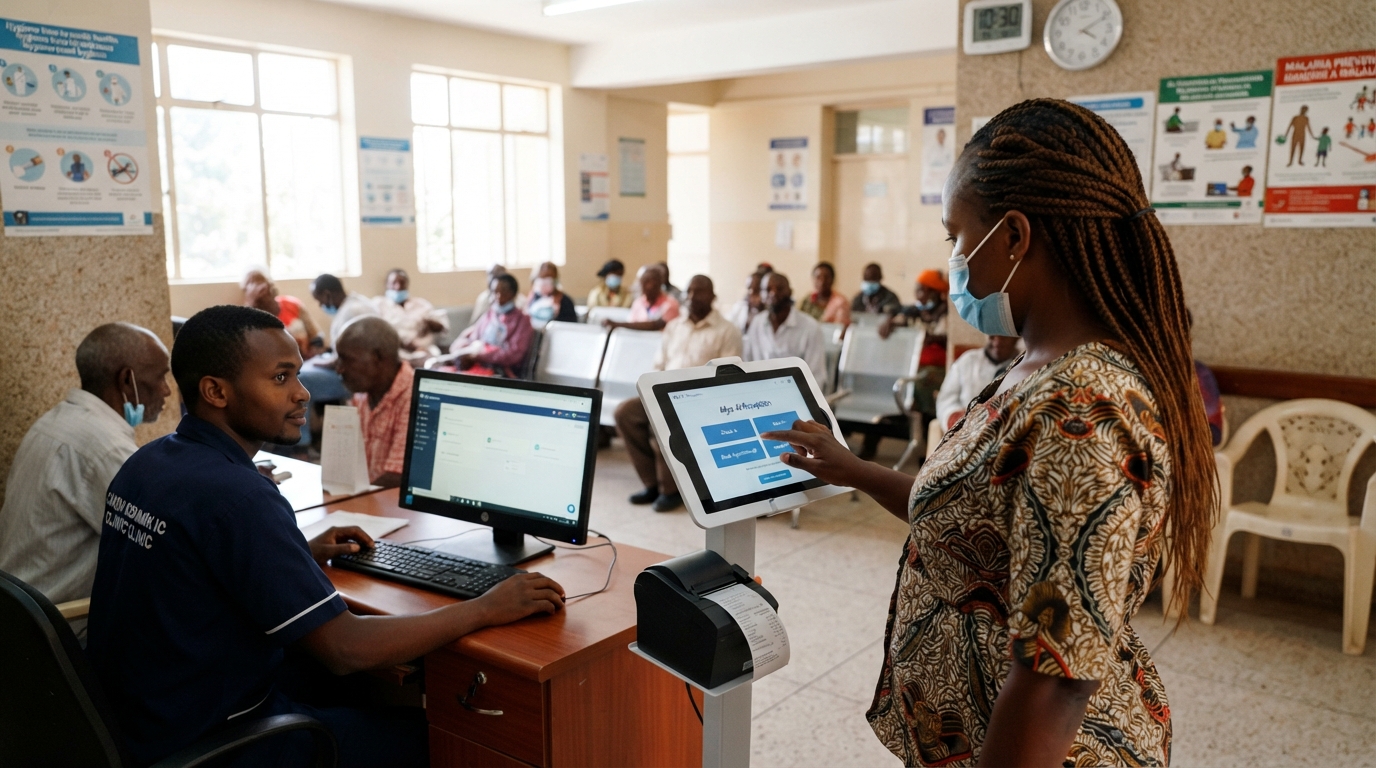
An AI receptionist for clinics in Kenya answers incoming calls, handles routine patient questions, and books or reschedules appointments without a front-desk staff member picking up every call. Clinics in Kenya often run with a small front-desk team that also manages patients physically present in the waiting room, which means phone calls compete directly with in-person care for staff attention. This article explains whether an AI receptionist can answer calls and book appointments for a clinic, how a Nairobi clinic can stop losing patient calls to a busy front desk, and what implementation actually involves.
Can an AI receptionist answer calls and book appointments for a clinic?
Yes, an AI receptionist can answer clinic calls and book appointments directly into a calendar, handling this without a staff member on the phone for every call. An AI receptionist is a voice-based AI system that answers business calls, handles routine questions, qualifies callers, and can book appointments or route calls to the right person.
For a clinic, this typically means the AI receptionist answers a call, asks what the patient needs, such as a new appointment, a reschedule, or a general question about services, and either books the appointment directly into the clinic's calendar or transfers the call to a staff member for anything more complex. A Nairobi clinic using this setup can have every appointment request handled the moment a patient calls, rather than the patient waiting on hold or getting a busy signal during peak hours.
This connects to broader AI receptionist use cases, where the same system can also send appointment confirmations and reminders after the call ends, reducing the number of separate manual steps required to complete a booking.
How can a Nairobi clinic stop missing patient calls?
A Nairobi clinic can stop missing patient calls by using an AI receptionist to answer every call instantly, including calls that arrive during peak hours, after closing, or when front-desk staff are attending to patients in person. Missed calls at a clinic often mean a lost appointment, since patients frequently call the next available clinic if their first call goes unanswered.
Clinic call answering through an AI receptionist works continuously, which matters most during the specific moments a clinic is most likely to miss a call: lunch hours, the last hour before closing, and any time the front desk is occupied with an in-person patient. Rather than relying on voicemail, which many callers do not use, the AI receptionist can capture the reason for the call and either resolve it directly or flag it for a callback.
A clinic can also use this to handle overflow during busy periods, such as flu season or a public health campaign, when call volume spikes beyond what front-desk staff can manage alongside in-person patients.
What can an AI receptionist handle for a medical clinic?
An AI receptionist can handle appointment booking, rescheduling, general service questions, and basic pre-visit information collection for a medical clinic. These are the call types that follow a predictable pattern and do not require clinical judgment.
Appointment booking and rescheduling
Medical appointment automation through an AI receptionist allows a patient to book a new appointment or reschedule an existing one by speaking naturally, with the system checking real-time availability and confirming the slot. This removes the back-and-forth of a staff member checking a paper diary or a separate booking system while the patient waits on the line.
General service and availability questions
Questions about clinic hours, which services are offered, whether a specific doctor is available, or what documents to bring to an appointment are common and repetitive. An AI receptionist can answer these directly, freeing front-desk staff from repeating the same information multiple times a day.
Pre-visit information collection
An AI receptionist can collect basic information ahead of a visit, such as the reason for the appointment or whether the patient is new or returning, and pass this along to staff before the patient arrives. This gives the clinic a head start on preparing for the visit without requiring a staff member to gather this information manually.
What should stay with clinic staff
Clinical questions, symptom assessment, and any conversation involving a patient's specific medical concern should go to clinic staff, not the AI receptionist. An AI receptionist is not a substitute for medical advice or triage by a qualified professional, and a well-configured system should recognize this and transfer the caller rather than attempt to answer.
AI receptionist options for clinics compared
| Option | Best for | Advantages | Limitations |
|---|---|---|---|
| Human front-desk staff only | Very low call volume, small single-doctor practices | Full personal attention, can handle any situation | Calls missed during busy periods or after hours |
| Voicemail with callback | Clinics wanting a low-cost fallback | No setup cost | Many patients do not leave voicemails, delays booking |
| AI receptionist for booking and FAQs | Clinics with moderate to high call volume | Answers every call, books appointments, works after hours | Requires setup and a clear escalation path for clinical questions |
| AI receptionist with CRM and calendar integration | Multi-provider clinics managing several schedules | Centralizes bookings, reduces double-booking risk | Higher setup complexity, needs a properly configured calendar system |
What does implementation involve for a clinic?
Implementing an AI receptionist for a clinic starts with mapping current call patterns, then connecting the system to the clinic's booking calendar and defining what gets automated versus escalated to staff. This ensures the AI receptionist reflects how the clinic actually operates rather than a generic call-answering script.
- Review current call volume and common call reasons, to understand which calls are repetitive versus complex.
- Connect the AI receptionist to the clinic's booking calendar or system, so it can check real availability and book directly.
- Define the call flow, including what questions the AI receptionist asks and how it responds to common requests.
- Set clear escalation rules, particularly for clinical questions or anything outside routine booking and FAQs.
- Test with realistic call scenarios before relying on the system for live patient calls.
- Review call logs after launch to catch any gaps in how the system is handling real patient questions.
Common mistakes to avoid
- Deploying an AI receptionist without a clear rule for transferring clinical questions to staff, which risks a patient not getting the medical guidance they need.
- Connecting the AI receptionist to a calendar that is not kept accurate elsewhere, which creates double bookings or missed appointments.
- Assuming the AI receptionist replaces front-desk staff entirely, overlooking in-person coordination and administrative work that still needs a person.
- Ignoring the Kenya Data Protection Act when the system collects patient names, phone numbers, and appointment reasons — review how this data is stored and consult a qualified professional.
- Failing to test the system with realistic call scenarios before going live, so problems surface with real patients instead of during setup.
Can an AI receptionist answer calls and book appointments for a clinic?
How can a Nairobi clinic stop missing patient calls?
Can an AI receptionist handle medical questions from patients?
Does an AI receptionist replace front-desk staff at a clinic?
How does an AI receptionist connect to a clinic's booking system?
Is an AI receptionist worth it for a small clinic with one or two doctors?
Conclusion
An AI receptionist for clinics in Kenya gives a small front-desk team the ability to answer every patient call and handle routine bookings without competing for attention with patients physically present at the clinic. The clearest results come from automating booking, rescheduling, and general questions while keeping clinical conversations with staff, and connecting the system to a reliable calendar from the start.
Every clinic's call patterns and booking process look a little different. Exponential Automations offers a free AI Readiness Snapshot that reviews your current call handling and booking process and identifies where an AI receptionist would help most.
See where your business stands
Take the free AI Readiness Snapshot to find your biggest visibility gaps and the highest-impact opportunities for your business.
Comments
No comments yet — be the first to share your thoughts.