
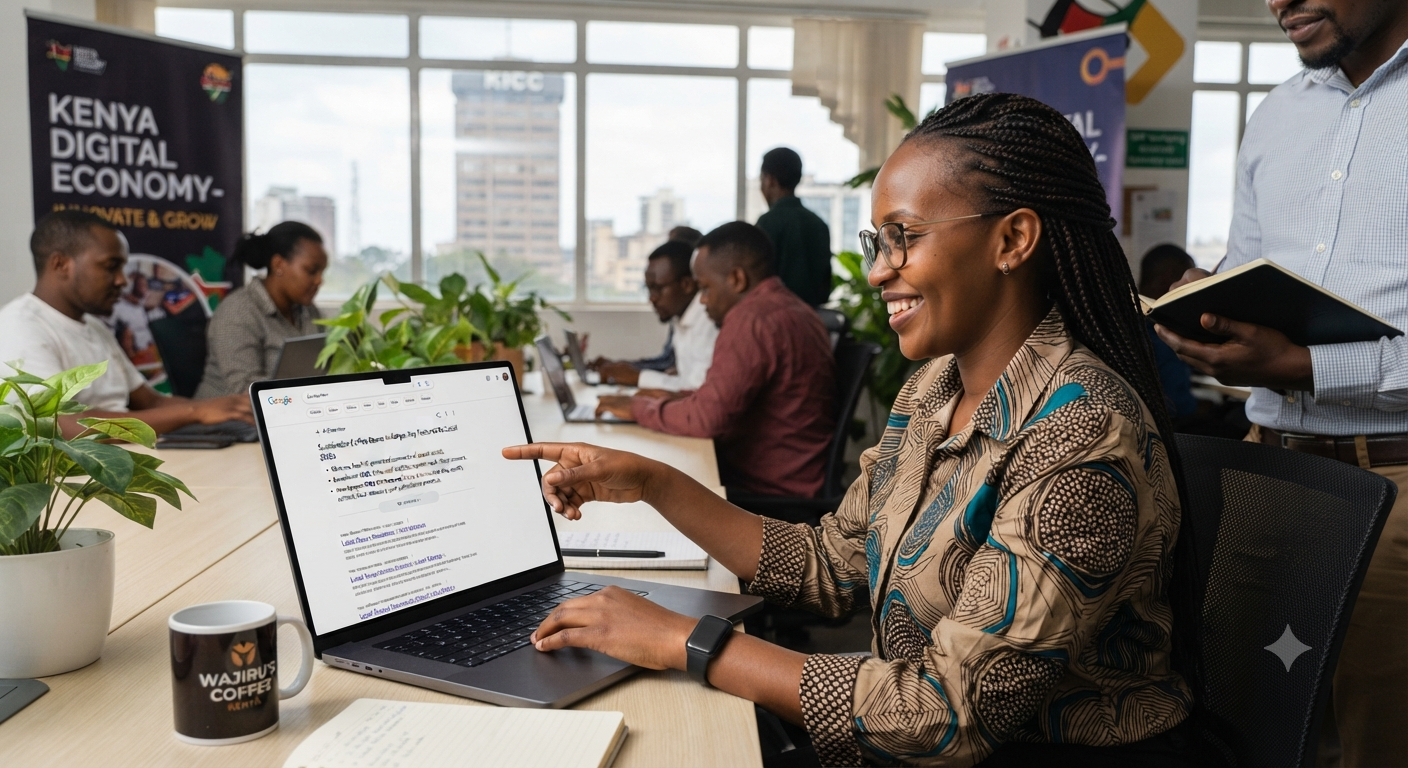
An AI Overview is a summary that Google generates at the top of search results, using AI to answer a question directly instead of just listing links. For Kenyan businesses, getting cited inside these summaries — alongside answers from ChatGPT, Perplexity, and Gemini — is becoming as important as ranking on page one of Google. A business that is invisible to AI answer engines is invisible to a growing share of its customers, including the Kenyan professionals and diaspora clients who now ask AI tools before they ask Google.
This shift affects real estate agencies in Nairobi, clinics in Mombasa, law firms in Kisumu, and hotels in Naivasha equally. The businesses that structure their content for AI readability now will be the ones AI systems trust and cite later.
What is an AI Overview?
An AI Overview is a Google Search feature that generates a written answer above the standard blue links, built from multiple web sources and displayed with citations. Google's AI reads content from several websites, synthesizes it into a direct answer, and links back to the sources it used. A Kenyan user searching "best accounting software for small business Kenya" might see an AI-generated summary before any individual website appears.
AI Overviews differ from traditional search results because they reward clarity over keyword density. Google's system looks for content that answers a specific question in a self-contained way, not content built around ranking tricks. This is why atomic, question-and-answer style writing performs better in AI Overviews than long, unstructured blog posts.
How is an AI Overview different from a regular chatbot answer?
An AI Overview appears inside Google Search results, while a chatbot answer like ChatGPT or Perplexity appears inside a separate conversational app. Both retrieve information from the web and generate a summary, but the citation behaviour differs. Google AI Overviews link to multiple sources directly within the answer box. Perplexity shows numbered citations next to each claim. ChatGPT's browsing mode cites sources only when web search is active, and Gemini blends AI Overview-style citations with Google's search index.
The practical difference for a Kenyan SME owner is small. All four systems pull from the same kind of well-structured, factual web content. Optimizing for one typically improves visibility across all of them, which is the core idea behind Generative Engine Optimization, or GEO.
What is GEO and how is it different from SEO?
GEO, or Generative Engine Optimization, is the practice of structuring content so AI systems can extract and cite it accurately, while SEO focuses on ranking pages in traditional search results. SEO is about keywords, backlinks, and Core Web Vitals. GEO is about answerability — writing content that gives AI models a clean, quotable answer to a specific question.
AEO, or Answer Engine Optimization, sits closely alongside GEO and focuses specifically on getting content selected as the direct answer to a question, whether that question is typed into Google or posed to ChatGPT. In practice, Kenyan SMEs need all three: SEO to be findable, AEO to be selected as the answer, and GEO to be trusted and cited by generative AI systems. Our Answer Engine Optimization service is built around exactly this combination.
| Discipline | Primary goal | What it optimizes | Example for a Kenyan business |
|---|---|---|---|
| SEO | Rank high in search results | Keywords, backlinks, Core Web Vitals, site speed | A Nairobi law firm ranking for "conveyancing lawyer Nairobi" |
| AEO | Be selected as the direct answer | Question-based headings, concise answers, FAQPage schema | A Mombasa clinic answering "what are the symptoms of typhoid" in one paragraph |
| GEO | Be cited by AI-generated summaries | Clear structure, factual accuracy, E-E-A-T signals, schema markup | A Kisumu accounting firm cited inside a ChatGPT answer about tax filing deadlines |
How do Kenyan businesses get featured in an AI Overview?
Kenyan businesses get featured in AI Overviews by publishing content that directly answers specific customer questions, backed by structured data that machines can read. Four concrete steps matter most, and each can be implemented without a large technical team.
- Answer real questions in plain language. AI systems favour content that states an answer in the first sentence, then explains it. A Nairobi real estate agency writing about mortgage rates should open with the current rate range, not a paragraph about the housing market.
- Add schema markup to every important page. Schema markup, written in JSON-LD, tells search engines and AI crawlers exactly what a page contains — a service, a location, a set of frequently asked questions.
- Build E-E-A-T signals into the site. Experience, Expertise, Authoritativeness and Trustworthiness is the framework Google uses to judge whether a source deserves citation. Publish author bios, client testimonials and verifiable credentials rather than simply more content.
- Keep the site fast and mobile-friendly. Core Web Vitals affect whether AI crawlers can access and index a site efficiently. Many Kenyan SME websites run on slow, image-heavy templates that crawlers skip over.
Why does this matter for Kenyan SMEs specifically?
Kenyan customers increasingly research on WhatsApp, Google, and AI chatbots before they call or visit a business. A financial services company that shows up when a Kenyan asks Gemini "how do I integrate M-Pesa payments into my online store" gains a lead the company never had to chase.
Kenyan businesses that pair AI visibility with AI automation capture that lead automatically. A WhatsApp automation system connected to a CRM can respond to the exact customer who found the business through an AI Overview, within seconds, in the channel the customer already trusts. Our workflow automation service handles that side of the equation.
Data protection also plays a role in AI visibility. AI systems favour sources that demonstrate credibility, and a Kenyan business that publishes a clear privacy policy aligned with the Kenya Data Protection Act signals trustworthiness to both AI crawlers and human customers.
Common mistakes Kenyan businesses make with AI visibility
- Writing vague, marketing-style headlines instead of direct questions. "Our Amazing Services" gives AI systems nothing to extract; "How Much Does an AI Receptionist Cost in Kenya?" gives them a citable answer.
- Ignoring schema markup entirely. Most Kenyan SME websites have no JSON-LD schema at all, which makes them functionally invisible to AI crawlers even when the content is good.
- Burying the answer under a long introduction. AI systems extract the first clear answer they find; three paragraphs of background loses the citation to a competitor.
- Treating AI visibility as a one-time project. AI Overviews change as new content is published and re-crawled, so a site that stops publishing gradually loses its citations.
Where should a Kenyan business start?
Start with the questions your customers actually ask, answer each one directly on its own page or section, and mark those pages up with LocalBusiness and FAQPage schema. Then keep publishing. Get a free AI Readiness Snapshot or speak to our team about building AI visibility and automation into your business.
What is an AI Overview in Google Search?
Can a small business in Kenya realistically get cited in an AI Overview?
Does AI Overview visibility replace the need for traditional SEO?
What is the difference between AEO and GEO?
How long does it take to see results in AI Overviews?
Do I need a developer to add schema markup to my website?
See where your business stands
Take the free AI Readiness Snapshot to find your biggest visibility gaps and the highest-impact opportunities for your business.
Comments
No comments yet — be the first to share your thoughts.