
Introduction
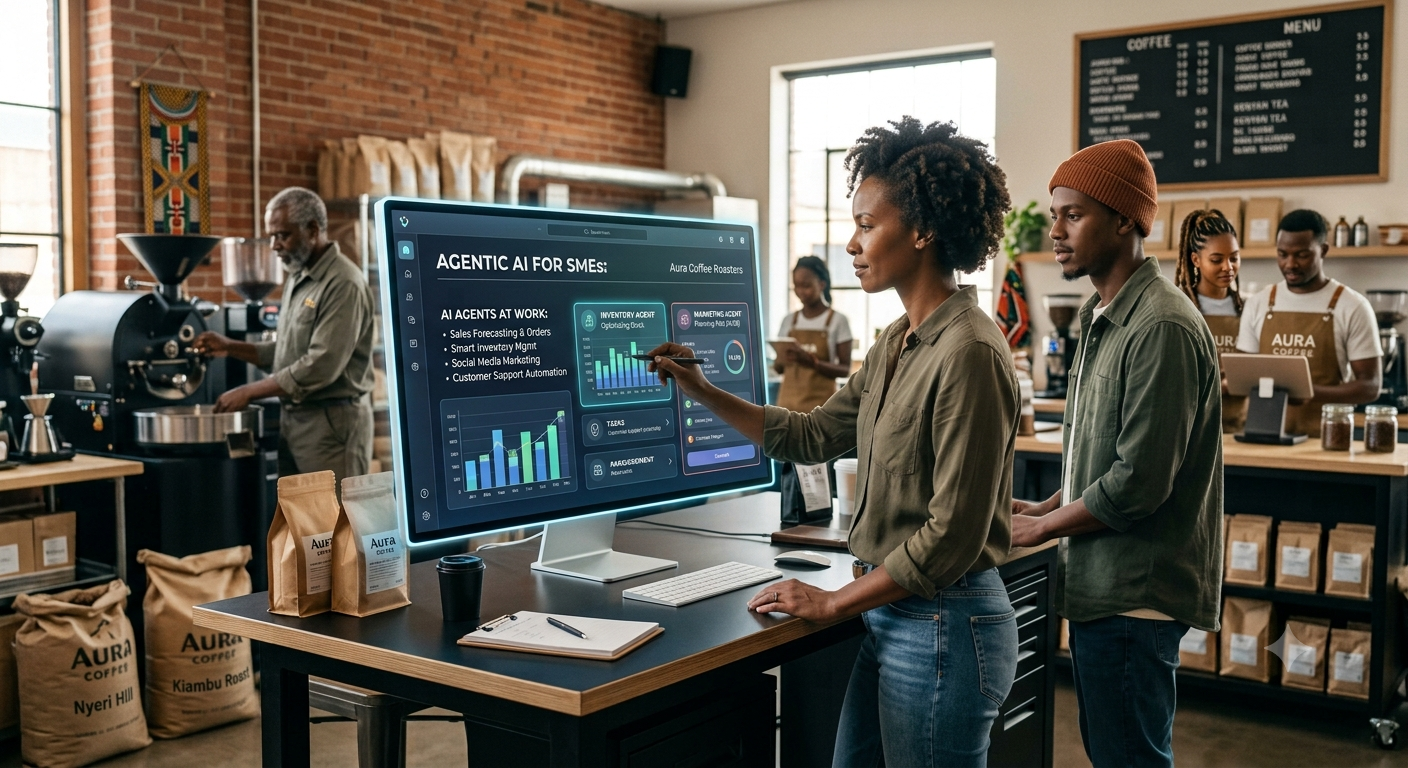
In 2026, a new wave of AI is moving from research labs into real business use. It is called Agentic AI — systems that can do more than just answer questions or follow simple scripts. These AI agents can understand goals, break them into steps, use tools, make decisions, and complete multi-step tasks with limited human supervision.
For Kenyan SMEs, this shift matters. Most businesses are still getting comfortable with chatbots, automated reminders, and basic dashboards. Agentic AI represents the next layer: autonomous workflows that can handle more complex processes end-to-end.
The opportunity is significant. Agentic systems could eventually manage entire workflows such as qualifying leads across multiple channels, following up consistently, scheduling viewings or appointments, processing payments, and updating records — with human oversight only for exceptions or complex cases.
However, like any powerful technology, it also brings new considerations around reliability, data privacy, and how much control businesses should hand over. This guide explains what Agentic AI actually is, why it is becoming relevant in 2026, what it could mean for Kenyan businesses, and how owners can think about it practically.
What Agentic AI Actually Means
Most AI tools used by Kenyan SMEs today are reactive. A chatbot answers a question. A reminder system sends a message. A dashboard shows data. These tools are useful, but they require human initiation or constant monitoring.
Agentic AI is different. An agent can be given a goal — for example, “Follow up with all leads from last week who have not responded and book a viewing if they are still interested” — and then independently:
- Check the CRM or conversation history
- Send appropriate messages via WhatsApp
- Interpret responses
- Check calendar availability
- Propose times
- Confirm bookings
- Update records
The agent does not just respond — it acts toward an outcome. This is why it is called “agentic.” It behaves more like a junior team member who can handle routine workflows while escalating only when it needs human judgment.
Why This Matters for Kenyan SMEs in 2026
Kenyan businesses already operate in a high-volume, multi-channel environment. Leads come through WhatsApp, websites, calls, and social media. Many owners and managers spend significant time on repetitive coordination tasks — chasing confirmations, following up on inquiries, reconciling payments, or updating records.
Agentic AI has the potential to take over more of these coordination layers. This could be particularly valuable in sectors where volume is growing but margins are tight:
- Real estate agencies managing dozens of property inquiries and viewings
- Clinics and hospitals handling appointment scheduling and patient follow-up
- Professional service firms managing client intake, proposals, and project coordination
- Hospitality businesses handling bookings, guest requests, and revenue management
The businesses that adopt these capabilities thoughtfully could handle significantly more volume with their existing teams — extending the “scaling without hiring” advantage even further.
Realistic Timeline and Current Limitations
While Agentic AI is advancing quickly, it is not yet fully autonomous in most business settings. In 2026, the most effective uses still involve human-in-the-loop designs. The AI handles routine steps and escalates when confidence is low or when exceptions occur.
Full autonomy without oversight remains risky for most commercial applications, especially where money, legal commitments, or customer relationships are involved. The most successful early adopters are using agentic workflows for well-defined, lower-risk processes while keeping humans in control of higher-stakes decisions.
Practical Opportunities for Kenyan Businesses
Some of the most promising near-term applications include:
- Lead qualification and follow-up workflows — An agent monitors new inquiries across channels, qualifies them according to defined criteria, sends relevant information, and books meetings or viewings when appropriate.
- Appointment and booking management — Agents handle rescheduling requests, send reminders, and manage no-show follow-up with minimal human intervention.
- Payment chasing and reconciliation — Agents can send polite payment reminders via WhatsApp, confirm M-Pesa transactions, and flag outstanding amounts for human review.
- Internal coordination tasks — Such as updating records across systems, preparing standard reports, or flagging anomalies in dashboards.
These are extensions of capabilities many Kenyan SMEs are already exploring with simpler automation, but executed with greater independence.
Risks and Considerations
Agentic AI introduces new considerations that Kenyan business owners should understand:
- Reliability and errors — Agents can make mistakes if not properly designed and monitored. Clear escalation rules and human oversight remain essential.
- Data privacy and compliance — Giving an agent access to customer conversations, payment information, and internal records requires strong data governance and compliance with the Kenya Data Protection Act.
- Cost and complexity — More advanced agentic systems are currently more expensive and complex to implement than basic chatbots or automation.
- Change management — Teams need to understand how to work alongside these systems and when to intervene.
Businesses that move too fast without proper controls risk damaging customer trust or creating operational problems.
How Kenyan SMEs Should Think About Agentic AI
Rather than rushing to adopt the latest agentic tools, most Kenyan SMEs will benefit from a staged approach:
- Strengthen the foundations first — Ensure your website is AEO-optimised, your WhatsApp and M-Pesa integrations are solid, and you have clean data flowing into a dashboard.
- Master simpler automation — Get comfortable with chatbots, reminders, and basic workflows before moving to more autonomous agents.
- Start with narrow, well-defined use cases — Choose one or two high-volume, repetitive workflows where errors have limited downside.
- Maintain human oversight — Design systems with clear escalation paths and regular review of agent decisions.
- Work with partners who understand both the technology and the local context — Implementation quality matters more than the latest features.
Frequently Asked Questions
Is Agentic AI ready for most Kenyan SMEs in 2026?
How is this different from the AI chatbots and automation already available?
Will this replace jobs in my business?
What should I ask a potential partner about Agentic AI?
How expensive is Agentic AI compared to regular automation?
Should I wait until the technology matures further?
Conclusion
Agentic AI represents the next evolution in how businesses can use artificial intelligence — moving from tools that assist humans to systems that can independently execute meaningful workflows. In 2026, this technology is becoming practical for specific business processes, though full autonomy remains limited and requires careful design.
For Kenyan SMEs, the most important step right now is not necessarily rushing to adopt agentic agents, but building strong foundations: clear processes, good data, native WhatsApp and M-Pesa integration, and connected visibility through dashboards. These foundations will make it much easier and safer to add more autonomous capabilities as the technology matures.
The businesses that will benefit most are those that treat AI as a multiplier of their existing team’s capability rather than a replacement for human judgment.
If you want to understand where your business currently stands and how emerging AI capabilities — including agentic workflows — could fit into your growth plans, start with our free AI Readiness Snapshot. It provides a clear assessment of your current systems and opportunities.
Or speak directly with our team about building the connected revenue systems that position your business for both today’s automation and tomorrow’s agentic capabilities.
Your business. Multiplied.
See where your business stands
Take the free AI Readiness Snapshot to find your biggest visibility gaps and the highest-impact opportunities for your business.
Comments
No comments yet — be the first to share your thoughts.