
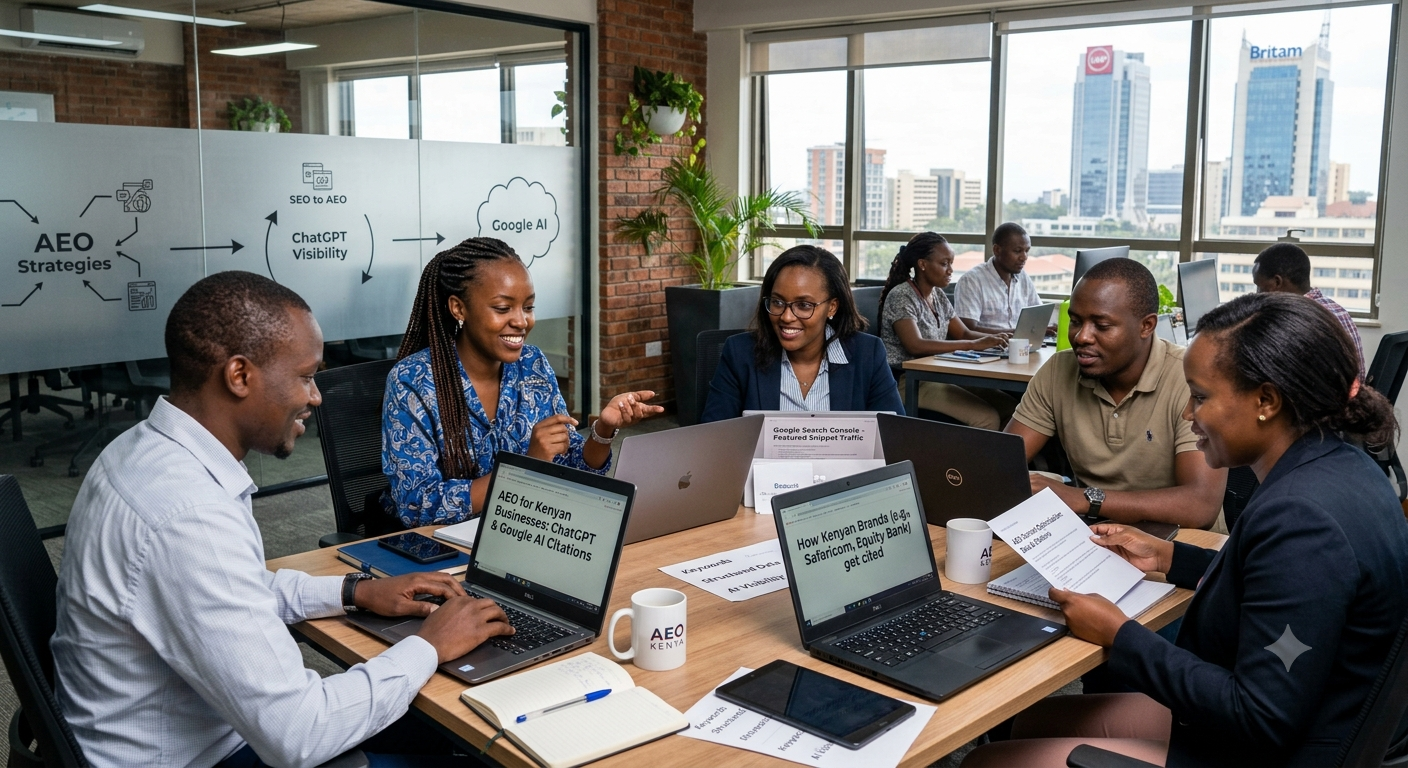
What is Answer Engine Optimization?
Answer Engine Optimization (AEO) is the practice of structuring your business's online content so AI systems like ChatGPT, Google AI Overviews, and Perplexity can find it, understand it, and cite it directly in their answers. For Kenyan and East African SMEs, this means a customer asking an AI assistant "best accountant in Nairobi" or "reliable caterer in Kisumu" can get your business name back as the answer, not just a list of blue links.
If you are already investing in search visibility, our SEO services build the AEO layer on top of that foundation.
How is AEO different from SEO?
SEO optimizes for ranking in a list of links. AEO optimizes for being the answer itself, quoted or paraphrased directly inside a chat response. The two overlap heavily, but they reward different things.
SEO success is measured by position on a results page and click-through rate. AEO success is measured by citation and inclusion, whether or not the user ever visits your site. A page can rank on page one of Google and still never get pulled into an AI Overview or a ChatGPT answer, because AI systems apply an extra filter on top of ranking: can this content be lifted cleanly and trusted at face value.
| Factor | SEO | AEO |
|---|---|---|
| Goal | Rank high in search results | Get quoted/cited in AI answers |
| Success metric | Position, click-through rate | Citation, direct inclusion |
| Content shape | Keyword-optimized pages | Atomic, self-contained answers |
| User outcome | Visits your site to find the answer | Gets the answer without visiting |
How do AI systems like ChatGPT and Google AI actually pick what to cite?
AI systems select sources by matching a query to content that answers it in a single, extractable block, then checking that the source carries enough trust signals to repeat without verification. Three things drive this: structure, clarity, and corroboration.
Structure means the answer sits inside a clearly labeled section, not buried in the fourth paragraph of a general essay. Google AI Overviews and Perplexity both favor content organized under a heading that mirrors the question asked. Clarity means one idea per paragraph, no hedging, no marketing language wrapped around the fact. Corroboration means multiple independent pages, directories, or reviews say the same thing about your business, which increases the AI system's confidence that the claim is true.
ChatGPT, when browsing is enabled, works similarly but leans more heavily on a small number of high-authority sources per query rather than aggregating dozens. This makes structured, first-party content on your own site more valuable for ChatGPT citations than for Google AI Overviews, which often pull from directories and third-party reviews alongside your website.
For a deeper walk-through of how AI answer engines choose which sources to cite, see this explainer video on Answer Engine Optimization.
What does a business need in place to get cited by ChatGPT?
A business needs first-party content that states facts about itself in plain, declarative sentences, plus a website structure that AI crawlers can actually read. Three requirements matter most in practice.
First, your website needs a dedicated page per service or offering, each answering "what is this, who is it for, what does it cost or involve" in the opening two sentences. Second, your business details, name, location, services, hours, and contact information, need to match exactly across your website, Google Business Profile, and any directory listings. Mismatched details create the kind of contradiction that makes AI systems hesitate to cite a source. Third, your site needs basic technical accessibility: a robots.txt file that does not block AI crawlers (GPTBot, Google-Extended, PerplexityBot), fast load times, and clean HTML without content locked behind JavaScript rendering that crawlers skip.
How does a business get found on Google AI Overviews specifically?
A business gets picked up in Google AI Overviews by ranking well organically first, then structuring that ranking content so Google's summarization layer can extract a clean answer from it. AI Overviews draw heavily from pages that already perform well in traditional search, then apply the same structure and clarity filters described above.
Schema markup helps here more than with ChatGPT. Adding structured data (LocalBusiness, FAQPage, Service schema) gives Google explicit, machine-readable signals about what your business does, where it operates, and what questions it answers. This does not guarantee inclusion, but it removes ambiguity that would otherwise disqualify a page from being summarized.
What role do Perplexity and Gemini play in this?
Perplexity and Gemini widen the set of AI systems a Kenyan business needs to appear in, and both reward the same underlying content quality as ChatGPT and Google AI. Perplexity behaves closer to a search engine with citations attached, pulling from a broad set of sources per query and showing its sources openly, which makes it a useful diagnostic tool: searching your own business name on Perplexity shows you exactly which pages it trusts enough to cite. Gemini, integrated into Google's ecosystem, draws on many of the same signals as AI Overviews, including Google Business Profile data, making profile completeness and consistency doubly important for Kenyan businesses that rely on Google's local search stack.
Why does this matter more for East African SMEs than for larger competitors?
It matters more because East African SMEs are frequently under-documented online relative to their actual quality and reliability, which means the gap between "a good business" and "an AI-citable business" is wider here than in saturated markets. Many established Kenyan SMEs have a functioning website and a Google Business Profile but no structured content answering the specific questions customers ask AI assistants. Fixing that gap is a smaller lift than in markets already crowded with AEO-optimized competitors, which means the first movers in a given city or sector see disproportionate benefit.
How can a business start optimizing for AEO today?
A business can start by auditing what AI systems currently say about it, then closing the gaps between that output and reality. Concretely:
- Search your business name and your core services in ChatGPT, Google AI Overviews, and Perplexity, and record what each one says.
- Rewrite your top three service pages so the first two sentences under each heading directly answer the question a customer would ask.
- Align your name, address, phone number, and service descriptions exactly across your website, Google Business Profile, and any directories you appear in.
- Add LocalBusiness and FAQPage schema markup to your site.
- Confirm your robots.txt file allows GPTBot, Google-Extended, and PerplexityBot to crawl your site.
Use our AEO audit checklist to score your current readiness and identify the highest-impact fixes first.
Frequently Asked Questions
Does AEO replace SEO?
How long does it take to get cited by an AI system after making these changes?
Can a small business with no technical team implement AEO?
Is AEO only relevant for businesses with a website?
Do I need to target ChatGPT, Google AI, and Perplexity separately?
The core answer
AEO gets Kenyan businesses cited by ChatGPT, Google AI, and Perplexity by pairing solid SEO fundamentals with content structured for direct extraction: clear headings that match real questions, answer-first paragraphs, consistent business details across every platform, and basic technical accessibility for AI crawlers.
If your business needs this built out properly, our AEO service page covers the audit, content restructuring, and schema implementation described above.
Your business. Multiplied.
See where your business stands
Take the free AI Readiness Snapshot to find your biggest visibility gaps and the highest-impact opportunities for your business.
Comments
No comments yet — be the first to share your thoughts.